



-
-
-
Total payment:
-



What Is Film Faced Plywood? 2026 Buyer’s Guide | TT Plywood
Posted by Thanh Uyên at 16/10/2023

Film faced plywood is a plywood panel covered with a resin-impregnated film, typically phenolic or melamine-based, to improve moisture resistance, abrasion resistance and surface durability. It is most commonly used for concrete formwork, but certain grades are also used for scaffolding platforms, transport flooring and industrial applications.
For importers, however, the term “film faced plywood” alone says very little about actual quality. Two panels can look almost identical while differing significantly in core construction, adhesive performance, film weight, thickness tolerance and expected reuse.
This 2026 buyer’s guide explains the specifications that matter, how to evaluate quality before ordering, and what to compare when sourcing film faced plywood from Vietnam or other manufacturing markets.

1. What Is Film-Faced Plywood?
Film-faced plywood is an engineered wood panel coated with a resin-impregnated phenolic or melamine film designed to improve moisture and abrasion resistance. Underneath this coated surface lies a multi-layer core made from hardwood (commonly eucalyptus or acacia), bonded with high-temperature WBP (Weather and Boil Proof) phenolic glue.
This construction produces a plywood sheet that is significantly more durable than ordinary commercial plywood. Its waterproof coating allows it to withstand high humidity, concrete pressure, mechanical abrasion, and repeated handling at construction sites.
For importers who want to understand surface differences, this comparison article from TT Plywood provides deeper insights into film variations:
👉 Black Film Faced Plywood vs Brown – Color Differences and Performance
https://ttplywood.com/black-film-faced-plywood-vs-brown-color-differences-and-performance-breakdown-tt-plywood-vietnam
Film-faced plywood is widely used in concrete formwork, scaffolding platforms, heavy-duty packaging, industrial flooring, truck beds, and reusable crates—making it one of the most versatile engineered wood products available today.
2. Common Film Faced Plywood Specifications Importers Should Compare
Film faced plywood is available in different sizes, thicknesses, core materials, glue systems, and surface options. For importers, these specifications are important because two panels with the same dimensions can perform very differently depending on their internal construction and bonding quality.
Before comparing prices between suppliers, buyers should therefore compare the complete specification rather than relying only on sheet size and thickness.
Common Film Faced Plywood Sizes and Thicknesses
Standard film faced plywood sheet sizes commonly supplied for international construction markets include 1220 × 2440 mm (4 × 8 ft) and 1250 × 2500 mm. At TT Plywood, commonly available thicknesses include 12 mm, 15 mm, 18 mm, and 21 mm, with other thicknesses available depending on order requirements.
A typical specification comparison may include:
| Specification | Common Options |
|---|---|
| Sheet size | 1220 × 2440 mm, 1250 × 2500 mm |
| Thickness | 12, 15, 18, 21 mm and custom options |
| Core | Acacia, eucalyptus or other hardwood constructions |
| Surface | Black/brown film, smooth or anti-slip |
| Film specification | Compare by film type and g/m² |
| Bonding | Depends on required exposure/performance level |
| Edge | Sealed edges recommended for moisture protection |
Exact specifications vary by supplier and project requirement. Importers should confirm tolerances and test requirements before ordering.
3. Why Film-Faced Plywood Matters in Construction Markets
Construction contractors choose film-faced plywood because it combines strength, durability, reusability, and cost efficiency. The phenolic-coated surface delivers a smooth concrete finish while protecting the plywood from water absorption and abrasion.
Across the EU and US, concrete contractors increasingly rely on film-faced plywood due to its favorable cost-per-use ratio. While steel formwork provides longer lifespan, film-faced plywood offers rapid installation, lighter weight, and significantly lower investment—benefits that appeal to small and mid-sized contractors.
These qualities make film-faced plywood a preferred choice in:
• Public infrastructure projects (bridges, tunnels, highways)
• Commercial buildings (offices, malls, industrial halls)
• Residential housing and affordable housing programs
4. How Film-Faced Plywood Is Manufactured
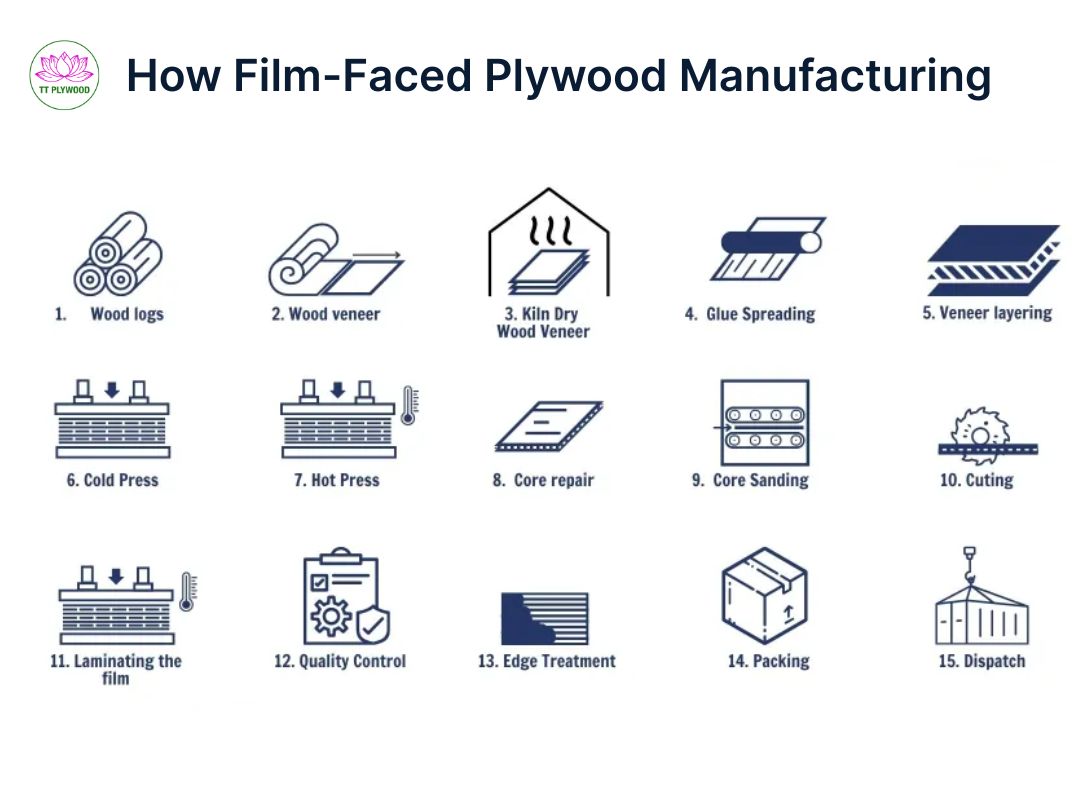
Understanding the production process helps importers evaluate a supplier’s technical capabilities. Film-faced plywood production typically includes log peeling, veneer drying, grading, core assembly, glue application, hot pressing, trimming, and edge sealing.
The pressing stage is especially critical. A calibrated hot press ensures consistent thickness, while high-temperature phenolic resin penetration helps improve bond durability and resistance to moisture exposure. Poor pressing results in bubbling, weak bonding, and premature delamination.
To understand the full production workflow, you can explore TT Plywood’s step-by-step technical guide:
👉 Manufacturing Process of Film-Faced Plywood
https://ttplywood.com/manufacturing-process-of-film-faced-plywood-a-step-by-step-guide
Factories in Vietnam, Malaysia, Indonesia, and China follow similar production methods, but quality varies widely depending on veneer grade, glue quality, and QC consistency.
5. Coating Types: Phenolic, Melamine, and Anti-Slip
Film-faced plywood is generally coated with one of three types of films:
- Phenolic film provides maximum waterproofing and abrasion resistance and is the preferred choice for heavy concrete formwork.
- Melamine film offers decent moisture resistance and is often used for cost-sensitive projects. Although it has fewer reuse cycles, it delivers a clean surface suitable for light construction or packaging.
- Anti-slip film features a wire-mesh texture used in truck flooring, scaffolding platforms, container floors, and industrial walkways where traction is required.
The type of film used directly affects durability, price, and recommended applications.
6. Film Weight and Glue Type


A common misconception is that film weight alone determines durability. In reality, the quality of the core structure and glue penetration is far more important.
Phenolic WBP glue increases moisture-resistant performance and supports higher reuse cycles. Melamine glue is suitable for medium-grade applications but not for high-pressure concrete pours. MR glue should not be used for exterior formwork.
The film weight, commonly ranging from 120–220 g/m², influences scratch resistance and surface stability. Film weight can contribute to surface durability, but a heavier film cannot compensate for poor core construction or weak bonding.
7. How Many Times Can Film Faced Plywood Be Reused?
There is no universal reuse number for film faced plywood. Actual service life depends on core quality, bond durability, film weight, edge sealing, concrete mix, release agent, stripping methods, cleaning and storage.
Instead of comparing suppliers only by a claimed number of reuses, importers should evaluate cost per use together with measurable panel specifications and sample performance.
A practical breakdown of reuse expectations is available here:
👉 How Many Reuses Can You Really Get From Film-Faced Plywood?
https://ttplywood.com/how-many-reuses-can-you-really-get-from-film-faced-plywood
Contractors using high-quality phenolic glue, smooth demolding oil, and proper handling typically achieve higher reuse numbers. Conversely, poor site practices—such as over-tightening screws or improper cleaning—can significantly reduce sheet lifespan.
8. Factors That Affect Durability
Durability in film-faced plywood depends on a combination of internal structure, glue performance, and protective surface layers. In practice, the following technical factors have the greatest influence on panel durability:
- Core veneer quality: Gaps, overlaps, and inconsistent veneer thickness weaken structural performance.
- Glue bond strength: WBP phenolic glue ensures waterproofing and long-term stability, especially in high-humidity environments.
- Film weight: Heavier films (≥120 g/m²) provide better abrasion resistance during repeated concrete pours.
- Pressing temperature & duration: Proper hot pressing ensures deeper glue penetration and prevents delamination.
- Edge sealing: High-quality edge coating prevents moisture infiltration and prolongs lifespan.
9. What Importers Should Check Before Buying
Before committing to a supplier, importers need to evaluate several critical technical and compliance factors to ensure the plywood meets international standards and avoids costly quality claims:
- Ask suppliers for QC reports covering thickness tolerance, moisture content, bonding strength, and density.
- Inspect veneer composition for core gaps, joint quality, and uniformity.
- Check the film type and film weight, and confirm whether they are suitable for the intended application.
- Request results from a boiling test, especially for WBP-grade panels.
- Confirm export experience with your target market (EU/US) to ensure compliance familiarity.
10. Why Vietnam Is Becoming the Top Source in 2026
Vietnam has rapidly emerged as a leading exporter of film-faced plywood thanks to its strong consistency and competitive pricing. Compared with other sourcing regions, Vietnamese mills often provide more stable hardwood cores and reliable WBP phenolic bonding strength, resulting in panels that perform well under demanding concrete formwork conditions.
Another important advantage is the industry’s investment in modern hot-press machinery and calibration lines, enabling better control over thickness accuracy and core stability. With certifications such as CARB P2, E1, and FSC, Vietnam meets the stringent compliance requirements of EU and US markets, making it a safe and low-risk sourcing option for international buyers.
Additionally, Vietnam’s competitive production costs and ability to customize specifications for different markets strengthen its position as one of the most dependable and efficient supply hubs for film-faced plywood in 2025.
If you’re sourcing film-faced plywood for concrete formwork, heavy-duty packaging, or industrial flooring, TT Plywood can support your business with FSC-certified, stable-quality, and export-ready panels.
👉 Request CIF/FOB Quotation Today
Email: info@ttplywood.com
WhatsApp: +84 32 694 2288
FAQ
1. How many times can film-faced plywood be reused?
There is no fixed number. Reuse depends on core quality, bonding, film surface, edge protection, formwork conditions and handling. Buyers should compare expected cost per use rather than relying only on a claimed reuse figure.
2. Is phenolic film better than melamine film?
Yes. Phenolic film provides superior waterproofing, heat resistance, and abrasion durability.
3. Why choose Vietnam as a sourcing base?
Vietnam offers stable quality, hardwood cores, strict QC, competitive pricing, and full compliance documentation for EU and US importers.
References
European Commission (2024). Construction Materials Market Outlook 2025. Brussels: EU Publications.
APA – The Engineered Wood Association (2023). Plywood & Formwork Standards. Tacoma, WA: APA.


