


-
-
-
Total payment:
-





Birch plywood is a hardwood plywood panel manufactured from birch veneers bonded together in a cross-laminated structure. Known for its strength, dimensional stability, and clean machining performance, birch plywood is widely used in furniture manufacturing, cabinetry, interior fit-outs, and precision woodworking applications.
Unlike standard commercial plywood that often uses mixed hardwood or softwood cores, birch plywood offers a more uniform structure and predictable performance, making it a preferred material for applications that require both durability and consistency.
Birch plywood is produced by stacking thin birch veneers with alternating grain directions and bonding them under heat and pressure. This cross-grain construction enhances structural stability and reduces the risk of warping, cracking, or deformation over time.
Thanks to its balanced structure and fine grain appearance, birch plywood is commonly selected for applications where material reliability and surface quality are important, especially in furniture and interior environments.
Compared to standard commercial plywood, birch plywood typically has:
When compared with MDF, birch plywood offers higher structural strength, better moisture resistance, and greater durability in long-term use.
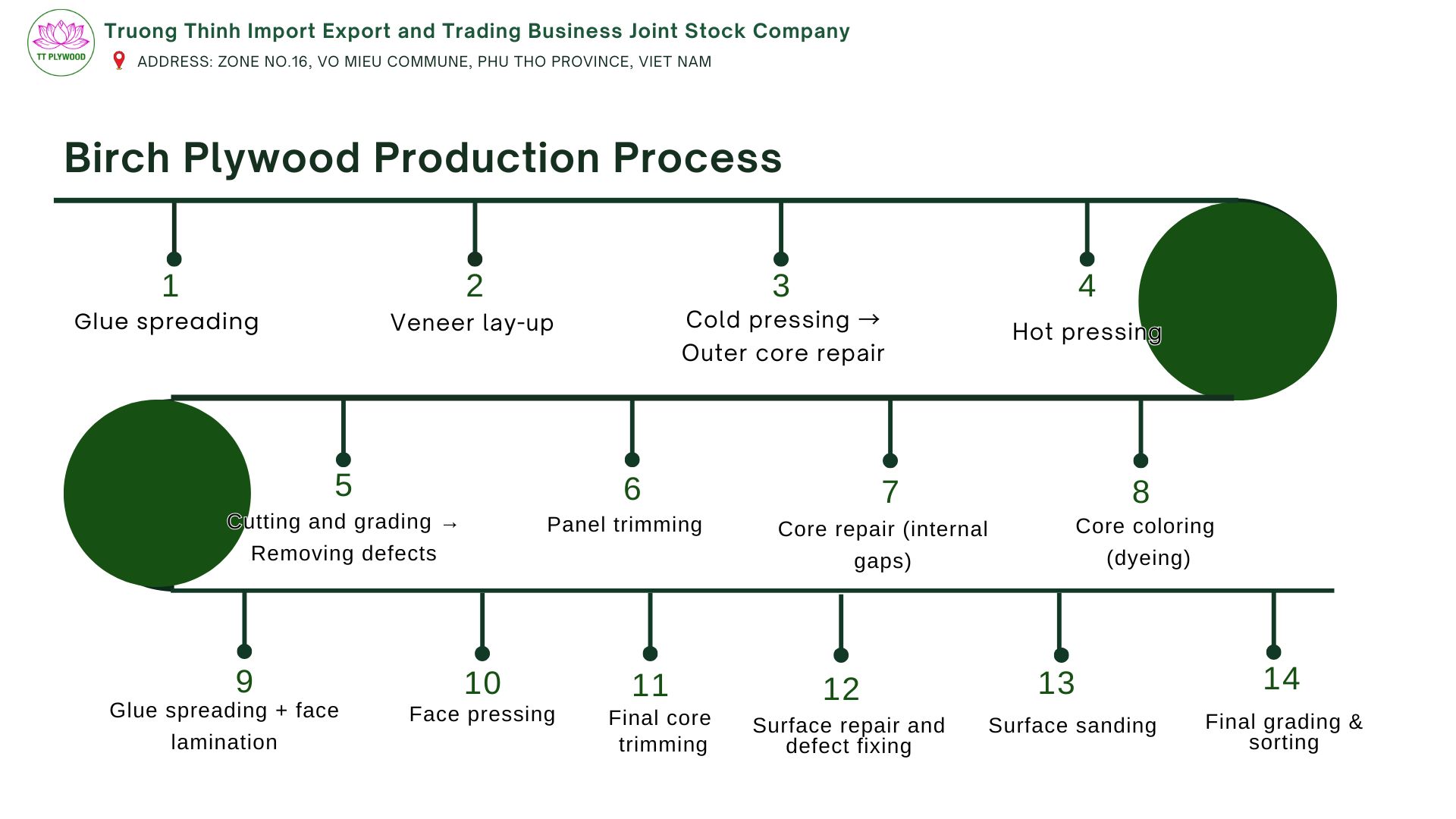
The performance of birch plywood is closely linked to how it is manufactured.
High-quality birch logs are rotary-peeled into thin veneers. Veneers are dried to controlled moisture levels to ensure stable bonding.
Veneers are stacked with alternating grain directions. This structure distributes loads evenly and enhances dimensional stability.
Depending on the intended application, birch plywood may be bonded with MR or WBP adhesives. Panels are hot-pressed to achieve consistent thickness and bonding strength.
This manufacturing process results in a panel that performs reliably during machining, assembly, and long-term use.
Birch plywood grades describe the visual quality of the face and back veneers rather than the structural strength of the panel.
Grade selection depends on whether the plywood surface will be visible in the final product. Structural performance remains consistent across grades when thickness and core construction are the same.
👉 Learn more in our detailed guide: Birch Plywood Grades Explained.
Common thicknesses include:
Each thickness is suitable for different structural and functional requirements.
Higher ply counts improve load distribution and edge strength, contributing to better long-term stability.
Birch plywood offers an excellent balance between strength and weight, making it suitable for both structural and interior applications.
Birch plywood is widely used for cabinets, tables, shelving, and furniture frames due to its stability and clean finish.
Used in wall panels, partitions, and interior structures where consistent performance is required.
Uniform core construction makes birch plywood ideal for CNC routing and precision cutting applications.
Birch plywood provides better consistency, strength, and machining performance, while commercial plywood is often chosen for cost-driven applications.
Birch plywood offers superior screw-holding strength, moisture resistance, and structural integrity.
Baltic birch plywood typically features more veneer layers and tighter tolerances, while standard birch plywood provides a broader range of specifications and sourcing options.
When selecting birch plywood, consider:
Balancing these factors ensures optimal material selection without unnecessary cost.
TT Plywood supplies birch plywood to furniture manufacturers, distributors, and project contractors across international markets.
Our strengths include:
We focus on aligning material performance with real-world usage requirements.
Is birch plywood waterproof?
Birch plywood can be manufactured with moisture-resistant or WBP adhesives depending on application needs.
What grade is best for furniture?
B/BB and BB/CP grades are commonly selected based on whether surfaces are visible.
Is birch plywood suitable for CNC machining?
Yes. Its uniform core structure supports consistent machining results.
What panel sizes are available?
Standard sizes are available, with custom dimensions upon request.
Nationwide delivery
Into money:


