



-
-
-
Total payment:
-




Cable Drum Plywood Flanges: Custom Sizes and CNC Precision
Posted by Thanh Uyên at 25/05/2026

Why Precision Matters in Cable Drum Manufacturing
As global demand for power cables, fiber optic systems, and industrial wiring continues growing in 2026, cable drum manufacturers are placing greater focus on component accuracy and structural reliability. One of the most critical elements in a cable reel system is the plywood flange.
Plywood flanges are not simply circular wooden parts attached to a drum. Their dimensional accuracy, core stability, and bonding strength directly affect cable winding performance, transportation safety, and the overall lifespan of the reel.
Today’s industrial buyers no longer accept rough-cut wooden flanges with inconsistent dimensions. Modern cable drum production increasingly requires CNC-machined plywood flanges with stable core structures, precise tolerances, and reliable moisture resistance for export applications.
For manufacturers in Europe, the United States, and industrial export markets, selecting the right plywood flange supplier has become a key factor in improving production efficiency and reducing operational risks.
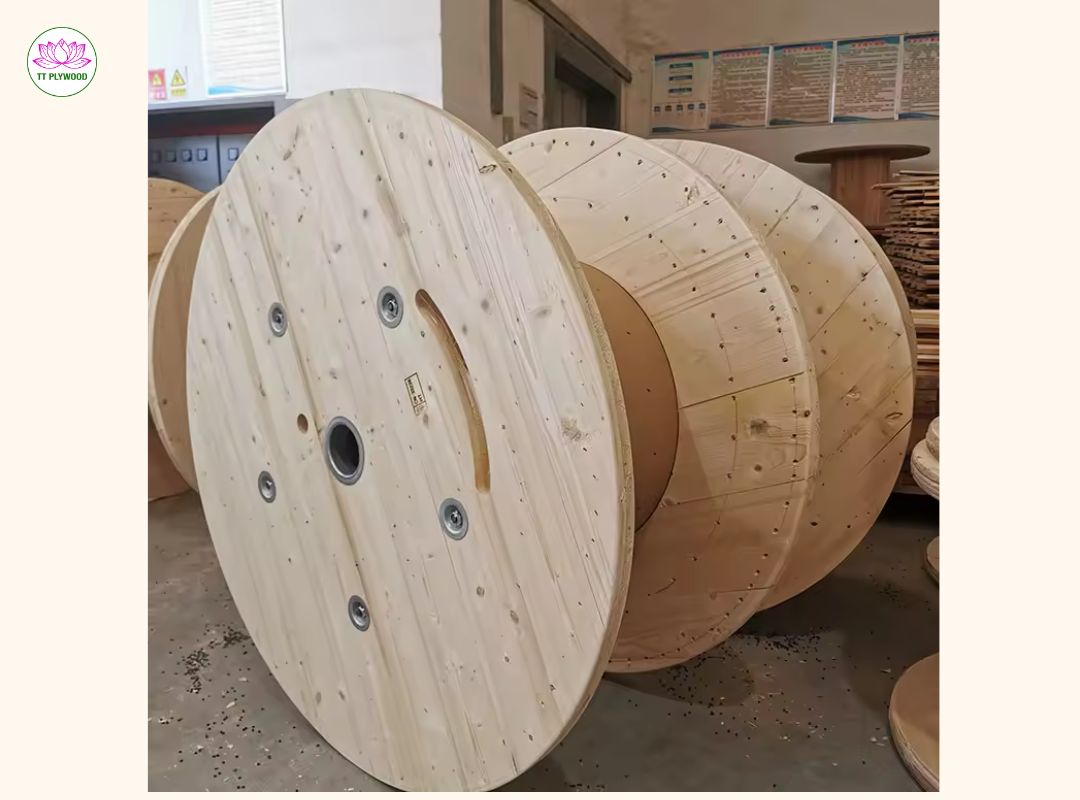
What Are Plywood Flanges for Cable Drums?
Plywood flanges are circular plywood components mounted on both sides of a cable drum or cable reel. Their main purpose is to secure and support the cable during winding, transportation, storage, and unwinding operations.
Compared with solid wood alternatives, plywood flanges provide better dimensional stability because the cross-laminated veneer structure distributes stress more evenly across the panel. This reduces the risk of cracking, warping, or structural splitting during handling and transportation.
Plywood flanges are commonly used for:
- Power cable drums
- Fiber optic cable reels
- Industrial wire reels
- Offshore cable packaging systems
- Telecommunications cable transportation
As cable drum systems become larger and more automated, plywood flanges are increasingly preferred because they offer more consistent machining quality and better structural reliability.
Why CNC Precision Is Essential for Plywood Flanges
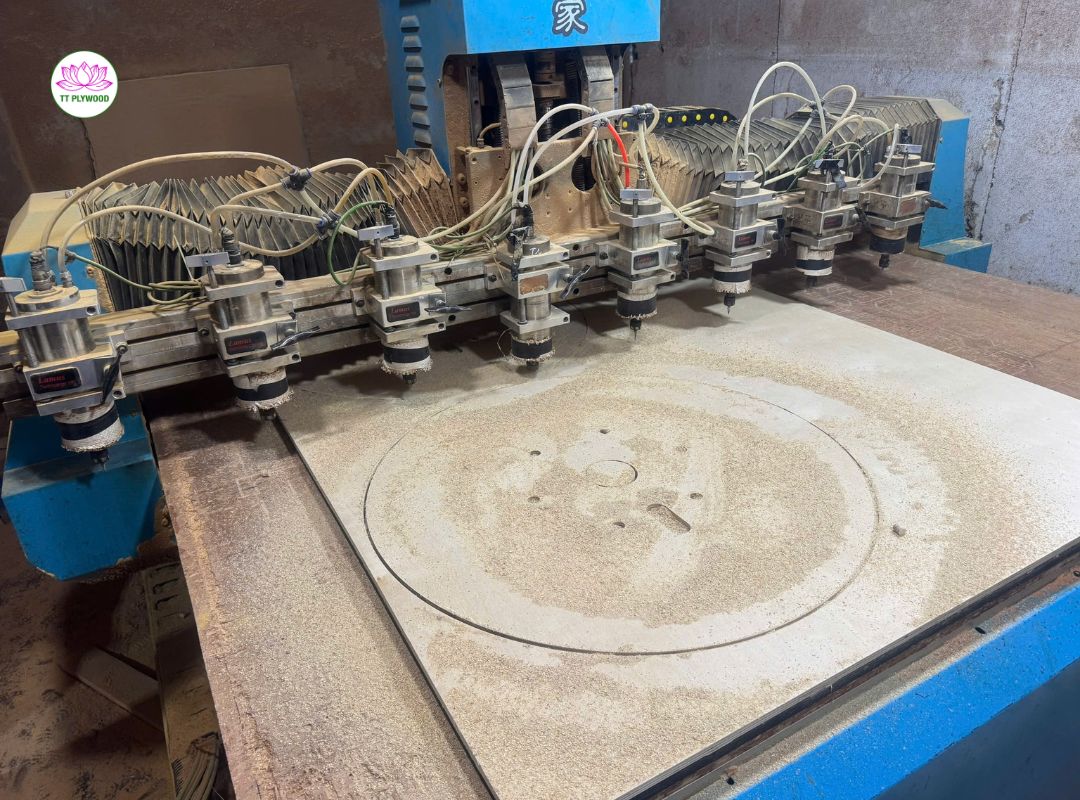
In industrial cable reel manufacturing, even small dimensional inaccuracies can create major operational problems. Poorly machined plywood flanges may cause uneven cable winding, reel imbalance, or vibration during transportation.
This is why CNC machining has become the standard production method for high-quality plywood flanges. CNC processing ensures precise diameter consistency, stable center hole alignment, and smooth edge finishing across every production batch.
Compared with manual cutting methods, CNC-machined plywood flanges provide:
- Better dimensional accuracy
- Cleaner edge finishing
- More stable reel rotation
- Improved assembly compatibility
For industrial cable manufacturers, precision directly affects operational efficiency. Accurate plywood flanges help maintain smooth winding performance and reduce handling issues during transportation and storage.
Plywood Core Structures Used for Cable Drum Flanges
The internal plywood structure plays a major role in determining flange durability and load-bearing capability. Different plywood core species provide different levels of density, screw-holding strength, and dimensional stability.
In industrial applications, hardwood core plywood is commonly preferred because it offers stronger structural performance compared with lightweight softwood alternatives. Eucalyptus core plywood, in particular, has become increasingly popular due to its stable density and cost-efficient durability.
Professional cable drum manufacturers also pay close attention to:
- Core consistency
- Internal void control
- Veneer bonding quality
- Moisture stability
Low-quality plywood cores with excessive voids may weaken the flange structure and reduce long-term durability under heavy cable loads.
At TT Plywood, plywood flange production focuses on stable hardwood core structures suitable for industrial reel manufacturing and export applications.
The Role of Glue Systems in Industrial Plywood Flanges
Glue quality is one of the most important factors affecting plywood durability, especially for cable drums exposed to humid environments or international shipping conditions.
Industrial plywood flanges typically use one of the following adhesive systems:
| Glue Type | Moisture Resistance | Typical Application |
|---|---|---|
| Melamine Glue | Moderate | Indoor storage applications |
| WBP Melamine | Improved humidity resistance | Industrial cable packaging |
| WBP Phenolic Glue | High water resistance | Outdoor and export cable drums |
WBP phenolic glue is widely preferred for export-grade plywood flanges because it provides stronger resistance against moisture-related delamination during long-distance transportation.
For cable drums stored outdoors or transported across multiple climate zones, reliable bonding systems are critical for maintaining structural stability.
Why Plywood Flanges Are Replacing Solid Wood Alternatives
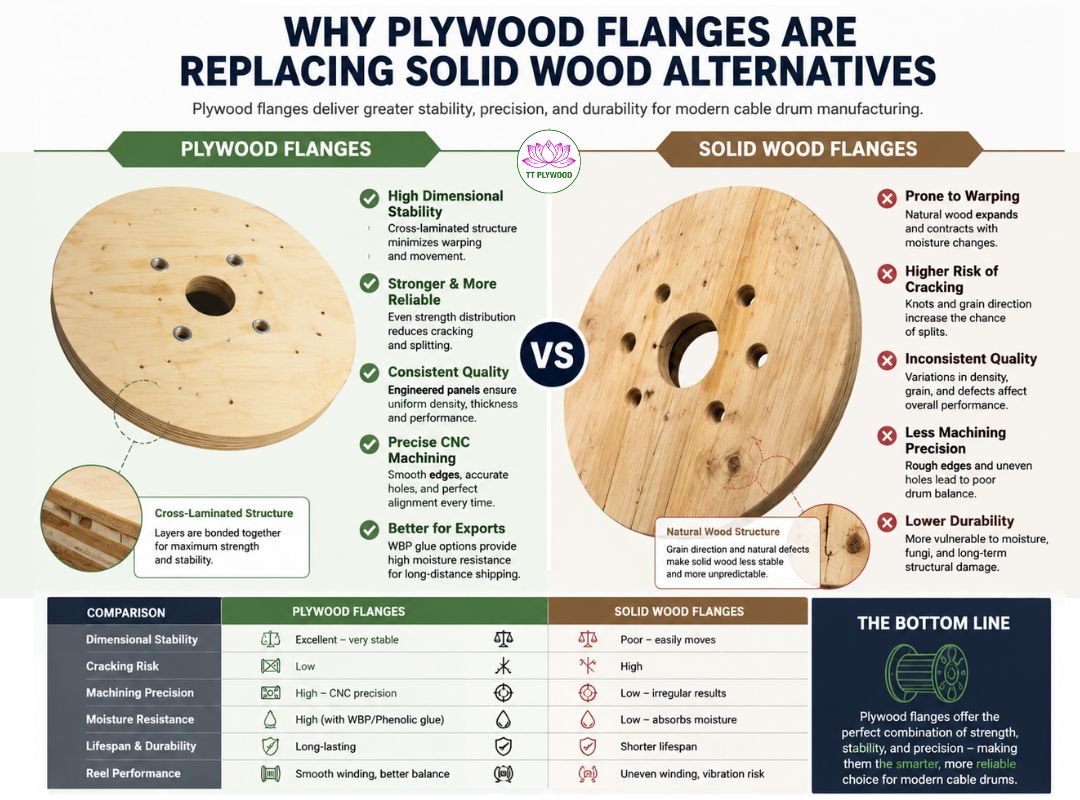
Traditional solid wood flanges often experience cracking and dimensional movement due to natural wood expansion and contraction. In contrast, plywood flanges offer a more stable engineered structure because the veneer layers are cross-laminated to reduce movement stress.
This engineered structure provides several advantages in industrial reel manufacturing. Plywood flanges are generally easier to machine consistently, less likely to split under load, and more reliable for high-volume production systems.
As industrial cable production becomes increasingly automated, manufacturers are prioritizing materials that deliver consistent performance and predictable machining results. This trend continues driving the shift from solid wood components toward engineered plywood flange systems.
Custom Sizes for Different Cable Drum Applications
Different industries require different cable drum dimensions depending on cable type, reel capacity, and transportation requirements. For this reason, custom plywood flange production has become increasingly important in industrial manufacturing.
Custom-sized plywood flanges allow manufacturers to optimize:
- Drum diameter
- Flange thickness
- Center hole dimensions
- Structural load capacity
Small telecommunications reels require lightweight and highly accurate flanges, while offshore cable systems may require much larger industrial plywood structures capable of supporting heavy winding loads.
Professional plywood flange suppliers increasingly manufacture products according to customer technical drawings and CNC specifications to ensure assembly compatibility and production efficiency.
Thickness and Structural Stability
Plywood thickness directly affects flange strength and deformation resistance. Thin plywood panels may reduce overall reel weight, but they can also increase the risk of bending or structural movement under heavy cable loads.
At the same time, excessively thick plywood may unnecessarily increase production cost and transportation weight. Modern industrial reel manufacturing therefore focuses on balancing material efficiency with structural reliability.
In 2026, many manufacturers are optimizing plywood engineering rather than simply increasing thickness. Stable core construction, proper glue systems, and accurate CNC machining often contribute more to performance than thickness alone.
Moisture Resistance and Export Durability
Cable drums are frequently exposed to changing environmental conditions during shipping and storage. Humidity fluctuations can damage low-quality plywood flanges, leading to warping, swelling, or delamination.
To improve export durability, professional manufacturers increasingly use:
- WBP phenolic glue systems
- Moisture-controlled hardwood veneers
- Precision CNC cutting
- Edge sealing technologies
These factors help maintain dimensional stability during long-distance transportation, especially for export shipments moving across multiple climate zones.
For industrial buyers, moisture resistance is not only about appearance. It directly affects structural reliability and transportation safety.
Surface Quality and Edge Finishing
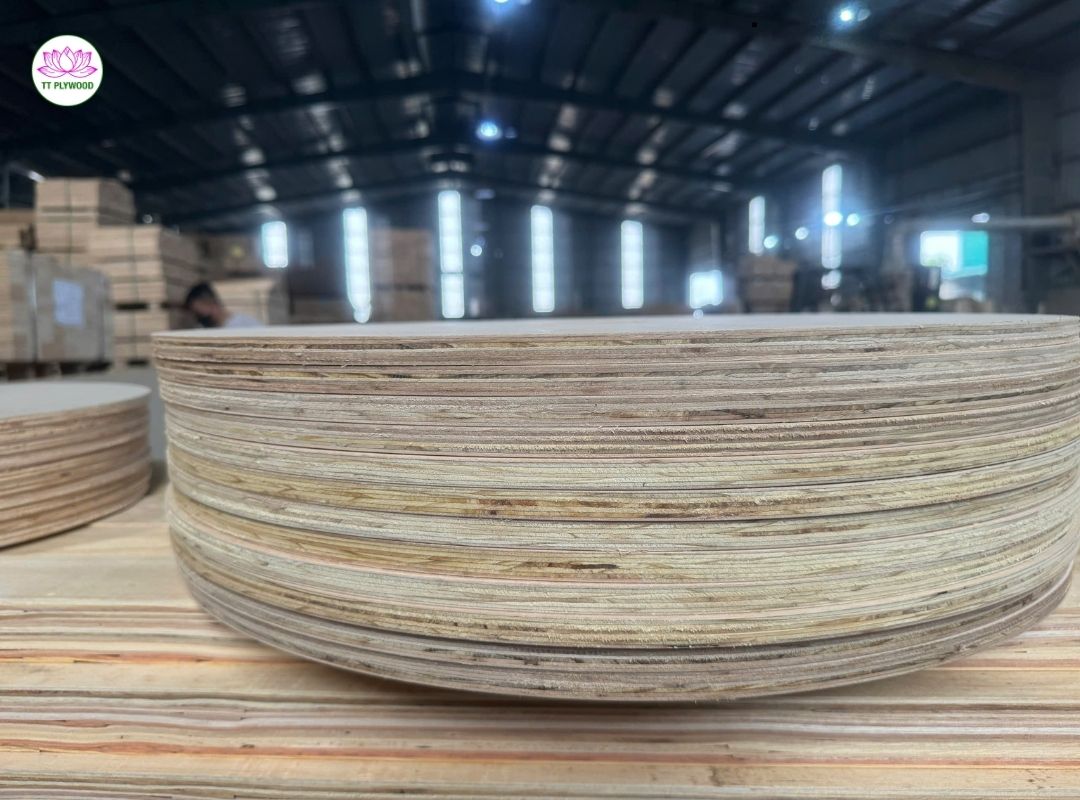
Edge finishing quality significantly affects both flange durability and visual consistency. Rough or damaged edges absorb moisture more easily and may crack during handling.
CNC finishing allows manufacturers to produce smoother and cleaner edges while maintaining dimensional consistency across large production batches. Some industrial buyers also request edge sealing systems or protective coatings to improve durability in outdoor storage environments.
Professional edge finishing not only improves appearance but also helps reduce long-term moisture-related damage.
Why Vietnam Is Becoming a Major Supplier of Industrial Plywood Components
Vietnam has become one of the fastest-growing plywood manufacturing hubs in the global market due to its expanding production capability, competitive pricing structure, and increasing investment in CNC technology.
Manufacturers such as TT Plywood continue improving industrial plywood production systems to meet the growing demand for cable drum flanges, industrial packaging plywood, and export-grade engineered wood components.
Buyers can explore industrial plywood solutions through the TT Plywood product portfolio for customized manufacturing requirements.
Common Mistakes Buyers Should Avoid
Many sourcing problems occur because buyers focus only on price while overlooking technical specifications and long-term durability requirements.
Common procurement mistakes include:
- Choosing low-density plywood cores
- Ignoring glue system specifications
- Using manually cut flanges instead of CNC machining
- Underestimating export humidity exposure
- Selecting incorrect plywood thickness
Professional cable drum manufacturers increasingly evaluate plywood flanges based on total operational performance rather than simply comparing raw material costs.
Conclusion: Precision and Durability Define Modern Cable Drum Plywood Flanges
In modern industrial cable reel manufacturing, plywood flanges are critical structural components that directly affect winding performance, transportation reliability, and operational safety.
As cable systems become larger and more demanding, manufacturers increasingly require plywood flanges with precise CNC machining, stable hardwood core structures, and reliable moisture-resistant bonding systems.
For buyers in global industrial markets, selecting the right plywood flange supplier is essential for ensuring production consistency, export durability, and long-term operational efficiency.
FAQ: Cable Drum Plywood Flanges
What plywood is commonly used for cable drum flanges?
Hardwood core plywood, especially eucalyptus core plywood, is widely used for cable drum flanges because it provides good structural strength, dimensional stability, and reliable screw-holding capability.
Why is CNC machining important for plywood flanges?
CNC machining ensures precise dimensions, smooth edge finishing, and accurate center alignment. This improves reel balance, cable winding consistency, and assembly efficiency during cable drum production.
Can plywood flanges be customized?
Yes. Professional manufacturers commonly produce plywood flanges according to customer technical drawings, CNC specifications, and dimensional requirements for different cable drum systems.
Why does plywood density matter for cable drum flanges?
Plywood density affects load-bearing capability, screw-holding performance, and structural stability. Low-density plywood may deform more easily under heavy cable loads.
How can moisture damage plywood flanges?
Poor moisture resistance may lead to swelling, warping, delamination, or dimensional instability. This is why industrial plywood flanges often use WBP bonding systems and moisture-controlled core veneers.
References
APA – The Engineered Wood Association. (2020). Engineered Wood Construction Guide.
Forest Products Laboratory. (2010). Wood Handbook: Wood as an Engineering Material.
European Panel Federation. (2023). Wood-Based Panels Market Overview.
ISO 780:2015 – Packaging and Distribution Standards for Industrial Handling.
FAO Forestry Products Report. (2022). Global Trends in Engineered Wood and Industrial Packaging Materials.


