



-
-
-
Total payment:
-



FSC vs EUDR: Is FSC-Certified Plywood Enough for EU Compliance?
Posted by Hoàng Anh Tuấn at 15/10/2026

A plywood supplier sends you a valid FSC certificate. The quotation includes an FSC claim, and the price meets your budget. Is that enough to prepare the order for the European Union Deforestation Regulation?
No. FSC certification can support EUDR due diligence, but it does not automatically establish compliance. Buyers still need the relevant product information, evidence and procedures required under the regulation.
For plywood importers, the key question is whether the supplier’s records can connect the finished panels to the wood used to manufacture them. A certificate is useful, but it cannot answer every sourcing question on its own.
FSC vs EUDR: What Is the Difference?
FSC is a voluntary certification system supporting responsible forestry and controlled sourcing. Forest Management certification concerns forest management practices, while Chain of Custody certification covers how eligible materials and claims are managed through the supply chain.
EUDR is an EU legal requirement for covered commodities and products, including plywood. It focuses on deforestation-free production, compliance with relevant laws in the country of production, and due diligence.
|
Criteria |
FSC |
EUDR |
|
Nature |
Voluntary certification system |
EU regulation |
|
Main focus |
Responsible forest management and supply-chain controls |
Deforestation-free and legally produced goods |
|
Typical evidence |
Certification records and product-specific FSC claims |
Origin data, supporting evidence and due diligence records |
|
Buyer’s responsibility |
Verify the certificate and the claim on purchased products |
Meet the obligations that apply to the buyer’s role |
|
Relationship |
Can support EUDR assessment |
Is not replaced by FSC certification |
FSC itself states that its Forest Management and Chain of Custody certifications do not replace due diligence.
For a broader overview of market requirements, read our plywood certifications guide
Why FSC Certification Alone Does Not Ensure EUDR Compliance?
The European Commission allows certification and third-party verification to support risk assessment. However, these schemes do not remove the operator’s responsibility to carry out due diligence.
An FSC certificate alone does not establish that a particular shipment has all the required origin data, that its sourcing risks have been addressed, or that the necessary regulatory submission has been made.
For purchasing teams, this means checking two things separately: whether the order carries a valid FSC claim, and whether the information needed for EUDR is available.
The current application date is 30 December 2026 for large and medium operators and micro and small operators already covered by the EU Timber Regulation. Other micro and small operators generally have until 30 June 2027. Buyers should confirm which category applies to their business.
Why Plywood Traceability Needs Extra Attention
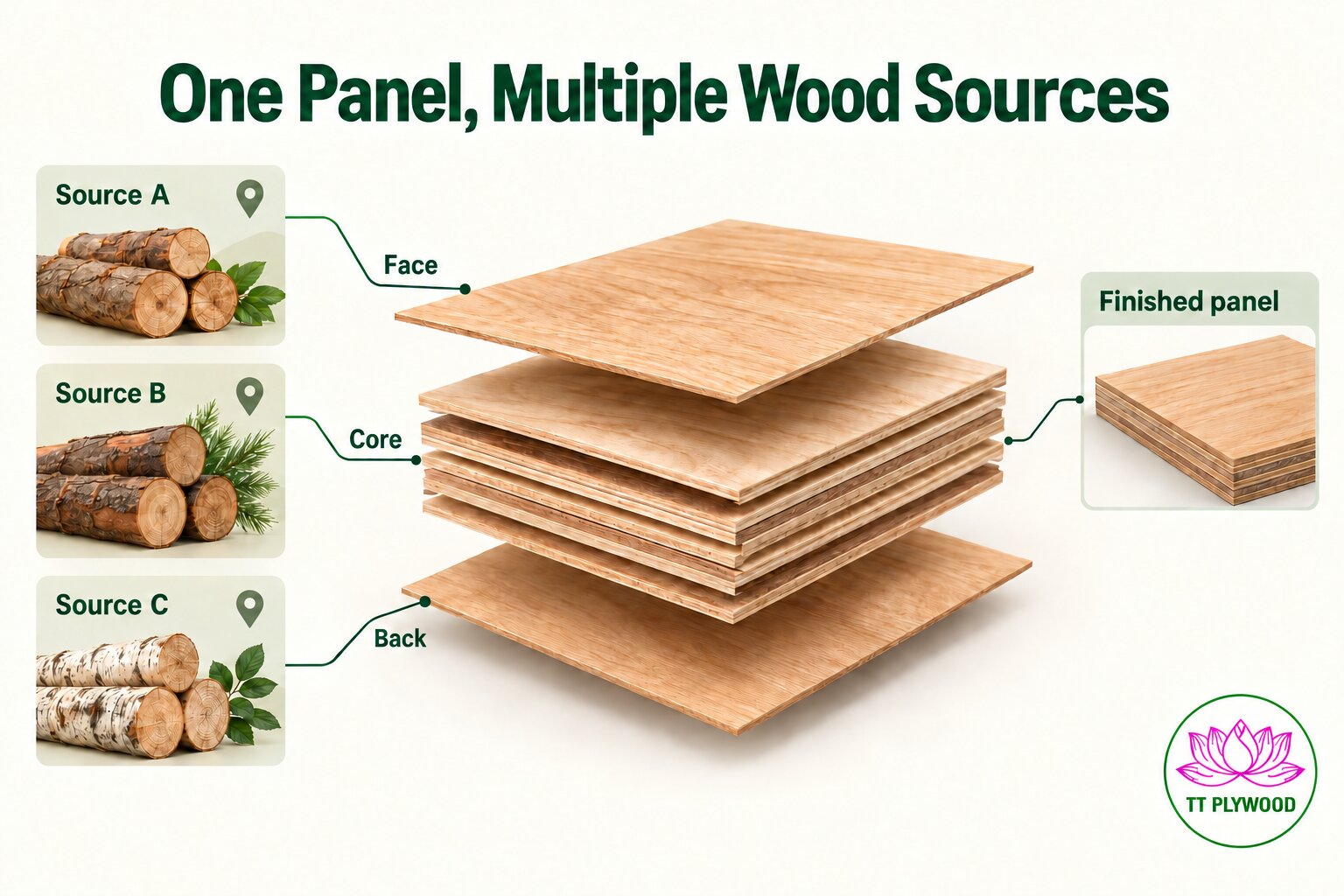
Plywood contains several veneer layers, and those layers may not share the same origin. A panel can have birch faces over a hardwood core, with veneers purchased from different suppliers.
Consider a buyer ordering birch-faced plywood. Recording “birch plywood, manufactured in Vietnam” describes the finished product, but it does not explain where the timber in the core was harvested.
Before placing an order, ask the manufacturer to identify the wood sources used for the faces, back and core. The supporting records should allow those inputs to be connected to the finished production batch.
This is especially useful when a factory changes veneer suppliers or substitutes a core species between orders. Agreeing on the documentation process early gives both parties time to resolve missing information.
What Information Should Buyers Request Beyond FSC?
For covered wood products, EUDR information requirements include wood species, country of production, relevant production plots and production dates or periods. Buyers also need evidence supporting legality and deforestation-free status. For timber, the common and full scientific names of the species are required.
Use the following table when discussing an order with a supplier:
|
Information |
What to check |
|
Wood species |
Identify the species used in the faces, back and core |
|
Country of harvest |
Distinguish timber origin from the country where plywood is manufactured |
|
Geolocation |
Obtain the relevant harvest-plot data; a factory address does not identify the forest |
|
Harvest date or period |
Connect the information to the timber used in production |
|
Legality evidence |
Check relevant harvesting rights, permits and supporting records |
|
Deforestation-free evidence |
Establish how the source meets the applicable EUDR requirements |
|
Production traceability |
Link veneer inputs and supplier records to the finished batch |
|
FSC documentation |
Verify certificate validity, scope and the claim on transaction documents |
An invoice, packing list or certificate of origin can support shipment identification. These documents should not be treated as substitutes for harvest-origin evidence.
Our guide to EUDR-ready plywood explains the wider sourcing considerations
Does FSC Mix Automatically Meet EUDR Requirements?
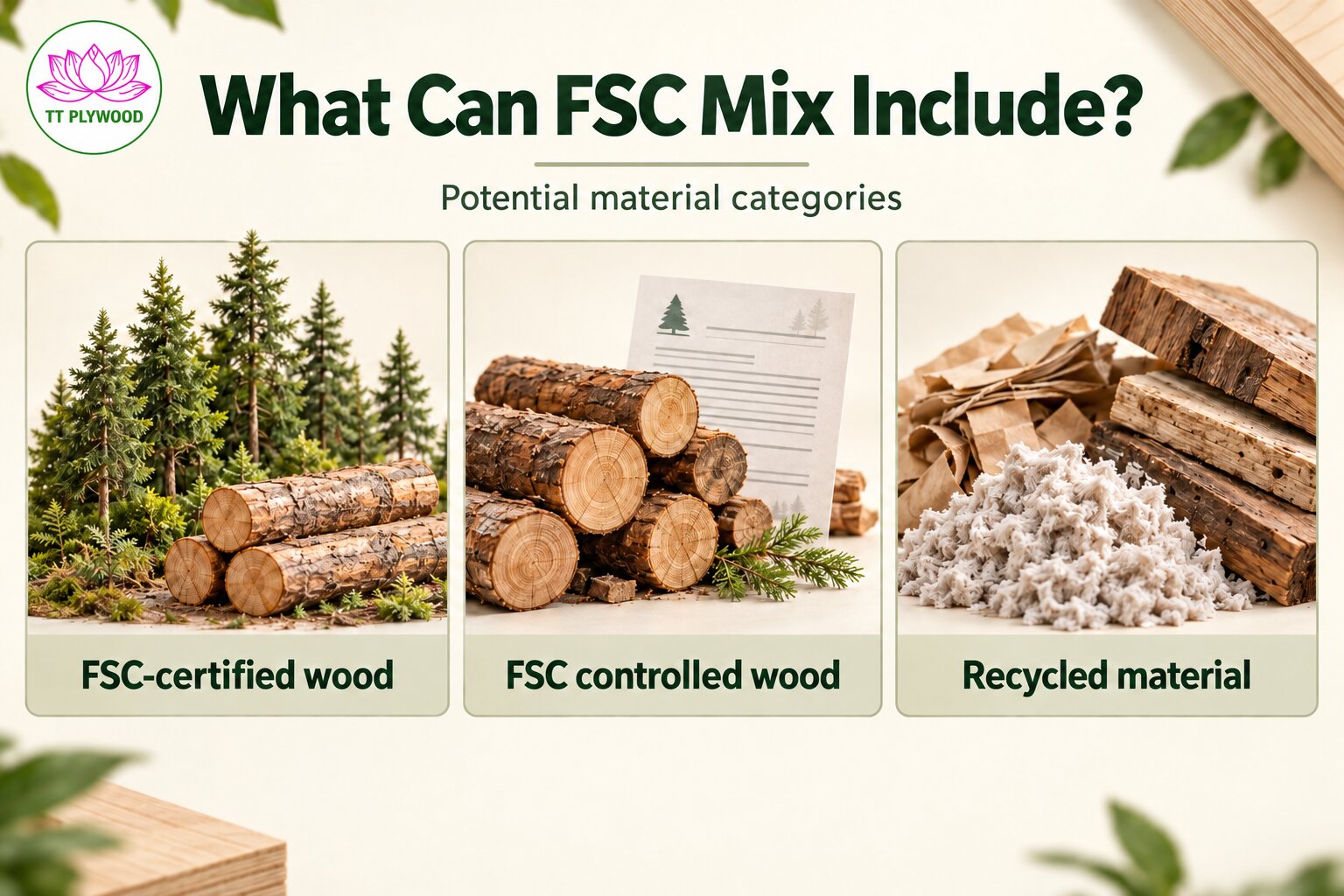
No. FSC Mix can include material from FSC-certified forests, recycled sources and/or FSC controlled wood. The label does not mean every wood input came from an FSC-certified forest.
This does not automatically make an FSC Mix product unsuitable for EU trade. It means buyers must examine the actual inputs and supporting information rather than assuming the label settles the EUDR assessment.
The same principle applies to FSC 100%: the claim provides useful sourcing assurance, but the operator still has EUDR responsibilities.
FSC offers additional support, including its voluntary Regulatory Module, risk assessment resources and traceability tools. Buyers should ask which systems a supplier actually uses and what information those systems can provide for the order.
A Pre-Order Checklist for Plywood Importers
Before approving a purchase order:
- Verify the FSC claim. Check the supplier’s certificate, product scope and transaction documents.
- Confirm the panel composition. Record the species and sources used for every veneer component.
- Request a sample documentation pack. Review it before production, while gaps can still be addressed.
- Check batch connections. Confirm how source records will be linked to the panels being shipped.
- Agree on responsibilities. Specify who supplies data, handles corrections and retains records.
Also confirm your own regulatory role. Under the revised EUDR framework, downstream operators and traders have different obligations from operators first placing covered products on the EU market. Not every business in the chain must submit a new Due Diligence Statement.
Frequently Asked Questions
Is FSC mandatory under the EUDR?
No. EUDR does not require FSC certification. Certification can support the assessment, but businesses must meet the regulation’s applicable requirements.
Can non-FSC plywood comply with the EUDR?
Yes, provided the product meets the relevant requirements and the responsible operator completes the necessary due diligence. Lack of FSC certification does not automatically establish non-compliance.
Who submits the Due Diligence Statement?
For a typical import of covered plywood from a non-EU supplier, the EU operator first placing it on the market handles the required submission. Suppliers provide supporting information, while downstream responsibilities depend on the business’s role.
Conclusion
FSC certification is a useful starting point for responsible plywood sourcing. EUDR preparation also requires buyers to examine the timber origins, supporting evidence and traceability of the specific order.
Before purchasing, confirm what the supplier can document for the faces, core and finished batch. Resolve missing information before shipment.
References
European Commission (n.d.) Regulation on deforestation-free products. Available at: https://environment.ec.europa.eu/topics/forests/deforestation/regulation-deforestation-free-products_en (Accessed: 12 October 2026).
European Commission (2025) Guidance document for Regulation (EU) 2023/1115 on deforestation-free products. Available at: https://environment.ec.europa.eu/document/download/5dc7aa19-e58f-42a3-bbbe-f0eb2e5a1d3a_en?filename=C_2025_2485_F1_ANNEX_EN_V3_P1_4056628.PDF (Accessed: 12 October 2026).
European Parliament and Council of the European Union (2023) Regulation (EU) 2023/1115 on deforestation and forest degradation. Available at: https://eur-lex.europa.eu/eli/reg/2023/1115/oj (Accessed: 12 October 2026).
European Parliament and Council of the European Union (2025) Regulation (EU) 2025/2650 amending Regulation (EU) 2023/1115 as regards certain obligations of operators and traders. Available at: https://eur-lex.europa.eu/eli/reg/2025/2650/oj/eng (Accessed: 12 October 2026).
Forest Stewardship Council (n.d.-a) FSC & EUDR. Available at: https://fsc.org/en/fsc-eudr (Accessed: 12 October 2026).
Forest Stewardship Council (n.d.-b) FSC Mix label and controlled wood. Available at: https://fsc.org/en/cw (Accessed: 12 October 2026).
Forest Stewardship Council (n.d.-c) FSC tools for EUDR. Available at: https://fsc.org/en/fsc-tools-for-eudr (Accessed: 12 October 2026).


