



-
-
-
Total payment:
-




Why Does Birch Plywood Have Patches? How to Inspect Veneer Repairs
Posted by Hoàng Anh Tuấn at 03/11/2026

You open a pack of birch plywood and notice oval or butterfly-shaped pieces across the surface. Their colour and grain differ from the surrounding veneer. Are these normal repairs, or should the panels be rejected?
Birch plywood patches are veneer inserts used to replace local defects, such as knots and holes. They can be acceptable in certain surface grades. Their presence alone does not establish that a panel is poor quality.
The purchasing question is whether the repairs meet the agreed specification and suit the finished product. A visible patch may be acceptable inside a cabinet but unsuitable for a clear-lacquered furniture front.
Why Are Patches Used in Birch Plywood?
Birch veneer is a natural material. Knots, holes and other local imperfections occur during growth or become apparent during processing.
Instead of discarding an otherwise usable sheet, manufacturers can remove a defective area and insert a fitted piece of veneer. Patching is an established production operation: Raute describes machinery that cuts, sizes and inserts patches to remove veneer defects (Raute, n.d.).
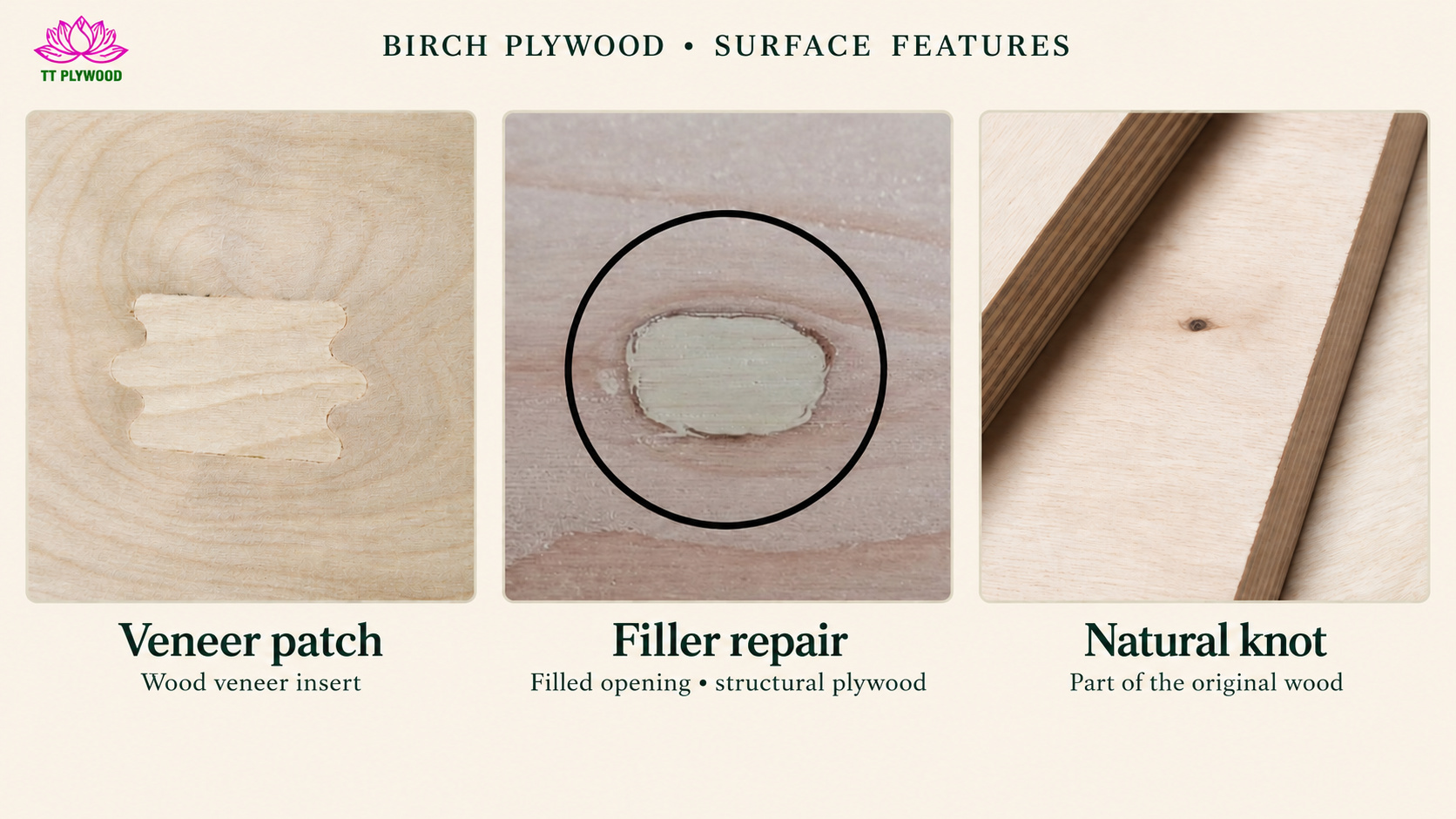
Veneer Patches, Filler and Knots Are Different
A wooden patch normally has a recognisable outline and its own grain. Filler occupies a repaired opening without reproducing the structure of a separate veneer insert. A knot is part of the original wood.
These features should be identified separately during inspection. WISA’s birch guidance distinguishes wooden plugs from repairs made with synthetic filler, while Metsä Wood lists wooden patches and putty repairs separately in its surface-quality guide (UPM Plywood, n.d.; Metsä Wood, n.d.).
A Repaired Face Does Not Describe the Whole Panel
A visible repair concerns the surface veneer. It does not reveal the condition of every internal layer or establish the panel’s bonding performance.
A patch-free face is therefore not a substitute for checking the core, thickness and other specified properties. Our guide to plywood face grade versus core quality explains this distinction
Are Patches Acceptable in Birch Plywood?
Yes—when permitted by the applicable surface specification and suitable for the intended finish.
Check the Supplier’s Actual Grade Definition
Do not assume every birch panel is sold with a patch-free face. WISA, for example, distinguishes its Premium surface without plugs from its BB surface, where wooden plugs are used. Its surface-appearance guide also lists different allowances by class (UPM Plywood, n.d.; UPM Plywood, 2023).
However, one manufacturer’s allowance should not automatically become the acceptance rule for another supplier’s product. Obtain the grading document applicable to the order.
Confirm the requirements for the face and reverse separately. A panel with a clean show face may have a repaired back that is entirely suitable for the application.
Match Appearance to the Final Finish
For clear lacquer or another transparent treatment, visible repairs need particular attention. WISA offers a separate premium product specifically for transparent surface treatments (UPM Plywood, n.d.).
For painted, laminated or concealed components, a repaired surface may be practical. Nevertheless, do not assume the finish will hide every outline or uneven area. Test the proposed coating on a representative repaired sample before approving bulk material.
How to Inspect Veneer Repairs
Start with a clean panel under good lighting. Look across the surface from a low angle to make raised edges and depressions easier to notice. Compare the sheet with the approved sample and written specification.
The following checks are a practical screening guide. Acceptance still depends on the agreed grade and application.
|
Inspection point |
What to look for |
What requires clarification |
|
Patch perimeter |
A fitted insert with a clearly identifiable boundary |
Open gaps, missing material or broken edges |
|
Surface level |
The repair sits evenly with the surrounding face |
A raised lip or recessed area that could affect finishing |
|
Repair condition |
The patch appears seated without lifted edges |
Loose, lifted or blistered areas |
|
Colour and grain |
Appearance matches the approved visual range |
Contrast unacceptable for the intended show face |
|
Quantity and distribution |
Repairs fall within the agreed allowance |
More or larger repairs than specified, or unexpected clustering |
|
Surrounding veneer |
The adjacent surface meets the specification |
Torn grain, sanding damage or other defects around the repair |
Examine Fit and Surface Level

Run a fingertip gently across the repair and inspect it with light falling across the face. A small straightedge can help identify local steps or depressions.
If an edge is lifted, photograph it before further handling. Do not pry at the insert as an informal acceptance test; damaging the sample makes the original condition harder to establish.
A visible line around a patch is not the same as an open gap. Record what is actually present rather than rejecting every outline.
Assess the Appearance on a Finished Sample
For visible furniture, inspect a sample with the intended finish applied. Review it under the lighting and viewing distance relevant to the finished product.
If colour contrast is acceptable inside a wardrobe but unacceptable on an exposed side panel, write that distinction into the order. “Good appearance” leaves too much room for interpretation.
Record Quantity, Size and Location
Ask whether allowances are expressed per sheet, per square metre or as a proportion of surface area. Manufacturer guides can use different measures: WISA lists a patch-count allowance for its BB class, while Metsä Wood expresses wooden-patch repairs as a surface-area allowance in its BB table (UPM Plywood, 2023; Metsä Wood, n.d.).
Use the measure specified for your product. A close-up photograph cannot establish how repairs are distributed across the complete sheet.
What Should Buyers Agree Before Ordering?
Ask for representative production samples, including examples of permitted repairs. One unusually clean sample is a weak reference for a grade that allows patched faces.
Record these points before production:
- The grading system and supplier’s grade description.
- Which side will be the visible face.
- Whether wooden patches and filler repairs are permitted.
- Any additional limits on repair size, quantity or location.
- The acceptable appearance after the intended finish.
- The inspection method and procedure for disputed sheets.
Keep wide photographs of complete panels alongside close-ups. Label them by face, grade and sample reference so both parties can use the same benchmark.
TT Plywood’s birch plywood range provides a starting point for discussing panel options. When requesting a quotation, include the intended finish and visual requirements as well as dimensions and quantity
Frequently Asked Questions
Do Patches Mean Birch Plywood Is Low Quality?
No. Repairs are permitted in some surface grades. The relevant question is whether the supplied repairs match the agreed grade and finish requirements.
Does a Patch Automatically Make the Panel Weaker?
Surface grade alone does not determine strength. WISA’s appearance guide explicitly separates surface grading from panel strength properties. Suspected bonding damage or a loose repair still needs assessment (UPM Plywood, 2023).
Can I Order Birch Plywood Without Visible Patches?
Yes, patch-free faces are available in certain product specifications. State the requirement explicitly, confirm availability and approve a representative sample.
Should Patched Sheets Be Rejected Immediately?
Not simply because patches are visible. Compare the sheet with the specification. Separate appearance differences from open, loose or otherwise defective repairs, then document any nonconformity.
A well-defined acceptance standard is more useful than a blanket “no patches” rule. Specify the surface the finished product needs, and inspect repairs against that requirement.
References
Metsä Wood (n.d.) Metsä Wood birch plywood: Guide to surface qualities. Available at: https://www.metsagroup.com/contentassets/42b1c1d79c43410c8762dcd1c6cc31e1/metsa_wood_birch_plywood_surface_quality_guide.pdf(Accessed: 26 October 2026).
Raute (n.d.) Increasing efficiency with automated veneer patching. Available at: https://www.raute.com/references/kutai-timber-indonesia/kutai-timber-indonesia/ (Accessed: 26 October 2026).
UPM Plywood (2023) Guide to WISA®-Birch plywood surface appearance. Available at: https://www.wisaplywood.com/siteassets/documents/brochures/guide-to-wisa-birch-plywood-surface-appearance-en.pdf(Accessed: 26 October 2026).
UPM Plywood (n.d.) About birch plywood. Available at: https://www.wisaplywood.com/specifying-wisa/about-birch-plywood/ (Accessed: 26 October 2026).
UPM Plywood (n.d.) WISA®-Birch Premium. Available at: https://www.wisaplywood.com/products/wisa-birch-premium/(Accessed: 26 October 2026).


