


-
-
-
Total payment:
-


Anti-Slip Plywood for Trailer Floors: Buyer Checklist
Posted by Hoàng Anh Tuấn at 09/11/2026

For trailer flooring buyers, the challenge is choosing a panel that suits the work it will face every day. A floor carrying parcels in a delivery van has different demands from one handling loaded pallet trucks in a freight trailer. Yet supplier quotations do not always make those differences clear.
A quotation for “18 mm black anti-slip plywood” leaves several important questions unanswered. Will the floor carry parcels, loaded pallet trucks or forklift traffic? How far apart are the supports? Does the reverse face need a smooth film?
Choosing anti-slip plywood for trailer flooring starts with the vehicle and its working conditions. Thickness, core construction, surface texture and test evidence should describe one agreed panel, supported by an approved floor design. Otherwise, two apparently similar offers may cover very different products.
Start with the Trailer and Its Load Conditions
Describe the Traffic Across the Floor
Tell the supplier whether the panels are intended for a trailer, delivery van or another vehicle. Describe what moves across them, including wheel types, concentrated loads and expected frequency. A pallet resting on the floor and a loaded trolley crossing a joint create different demands.
Separate pedestrian slip resistance from resistance to cargo movement. A result involving a shoe sole does not automatically describe how a pallet behaves during braking. HSE guidance also treats contamination, footwear and cleaning as relevant to pedestrian slip risk (HSE, n.d.).
Include exposure to rain, muddy boots, oil or washing where relevant. These details help identify which evidence is useful and which questions still need the vehicle designer's attention.
Match Thickness to the Supporting Structure
An 18 mm panel is not a universal trailer-floor specification. Send a drawing showing support spacing, panel joints, fixing positions and the intended load paths. State whether the floor is a new design or a replacement for an approved component.
Metsä Wood's installation guidance illustrates how span, plywood orientation and panel structure affect floor selection (Metsä Wood, 2024). Its numerical examples apply to the products and arrangements described there; they should not be transferred to another supplier's plywood.
Where load capacity matters, obtain engineering confirmation for the actual panel and installed structure before ordering.
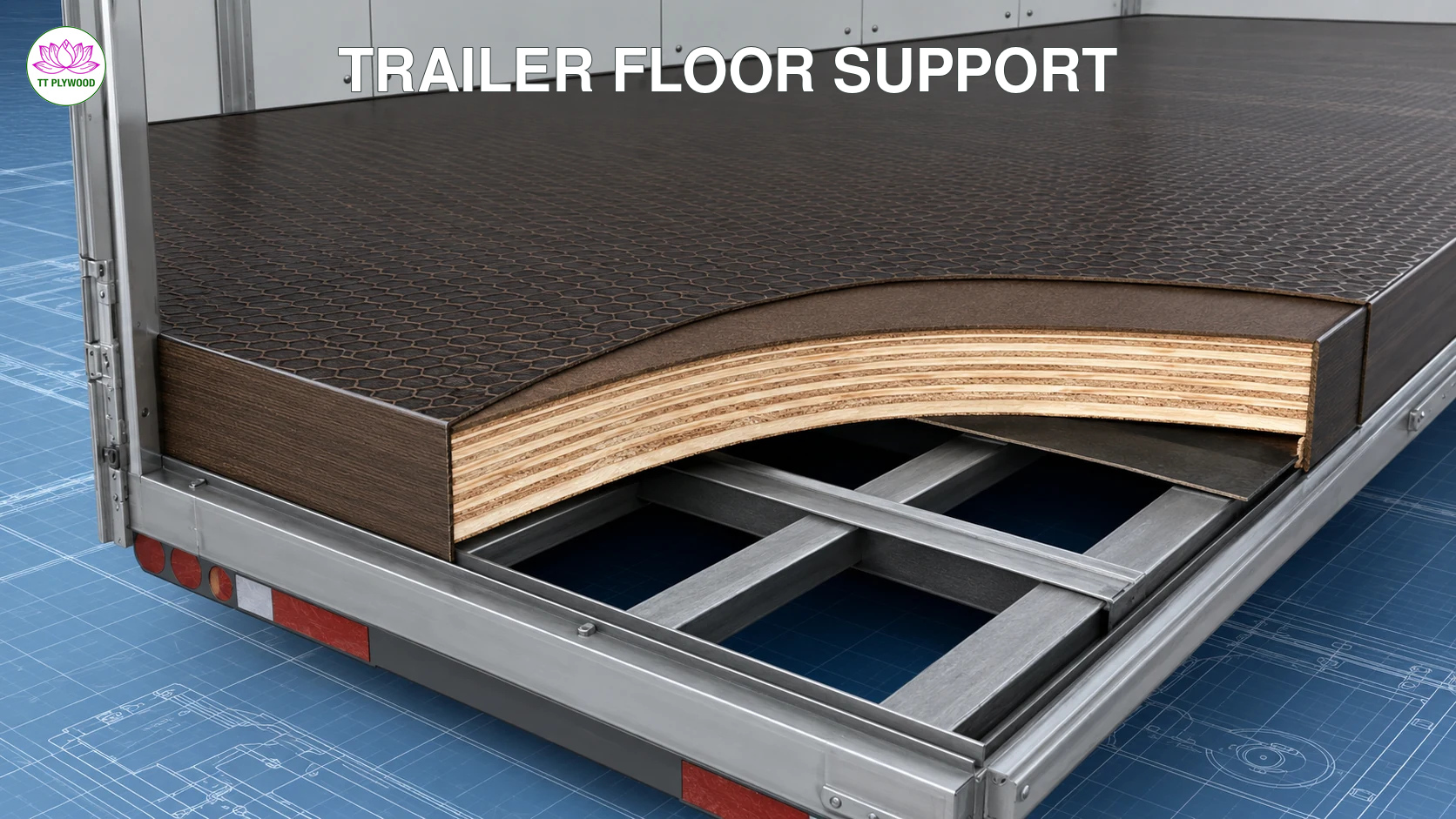
Specify the Panel Beneath the Pattern
Confirm Core Construction and Bonding
Ask for the core species, construction and ply arrangement, together with the bonding requirement. “Hardwood core” is too general when different constructions are being compared. Request a labelled cross-section sample and information identifying the quoted product.
Write the required bonding class and test method where these form part of the specification. EN 314-1 concerns bonding test methods, while EN 314-2 gives bonding-quality requirements (BSI, 2004; BSI, 1993). The word WBP alone does not provide that level of detail.
For an overview of the product category, see our anti-slip film faced plywood guide
Define Both Faces
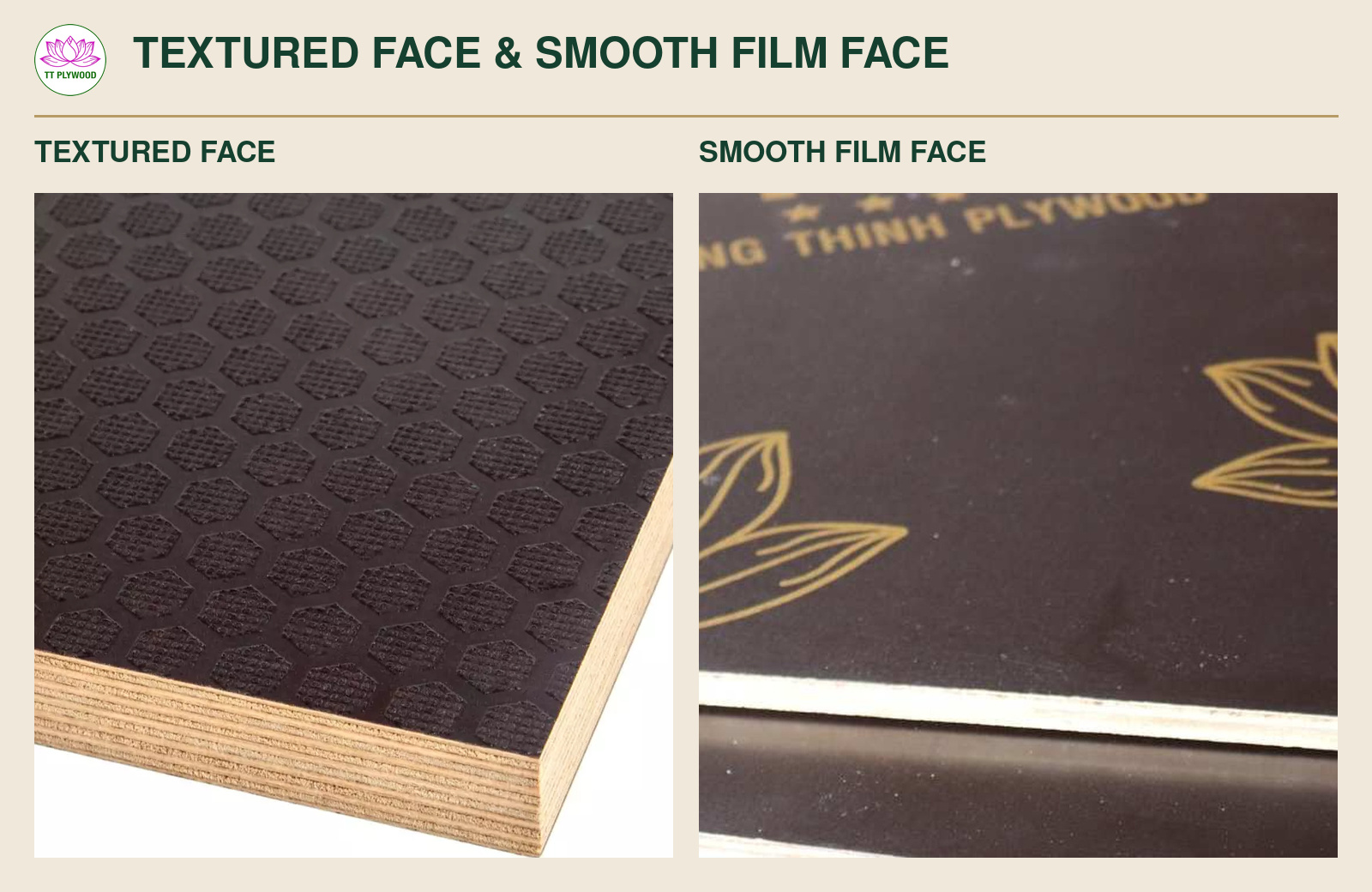
Approve the working surface with an actual sample or a clearly identified close-up photograph. Names such as hexagon anti-slip plywood and rice-grain anti- slip plywood are useful descriptions, but suppliers may use them differently.
Record the film specification for each side, State the film weight in g/m² for each face and ask the supplier to clarify what the quoted figure represents. Confirm whether the reverse should be smooth or textured. Also identify the working face on the drawing if the panel will be machined.
Film weight should not become a shortcut for overall floor quality. Our article on whether heavier film means better film faced plywood explains the distinction
Agree on Dimensions and Edge Protection
Use Delivered Dimensions and Written Tolerances
Specify finished length, width and thickness, rather than relying on nominal sheet size. Add the agreed tolerances, measurement positions and any requirements for squareness or flatness. Where machining is included, attach a controlled drawing with its revision number.
Manufacturing tolerance and installation clearance serve different purposes. The first controls the delivered panel; the second allows the assembly to work as designed. Asking the factory to cut to “the available opening” without discussing clearance can create an avoidable fit problem.
nclude Site Cuts and Drilled Holes
Confirm which edges and holes receive factory sealing and who seals surfaces exposed during installation. Metsä Wood's guidance specifically addresses protection of freshly machined surfaces (Metsä Wood, 2024).
Use a compatible sealing system and the relevant application instructions. A dark painted edge does not, by itself, prove complete coverage or suitability. Request photographs of corners, cut-outs and the reverse face as well as the working surface.
Request Evidence Before Approving the Order
Keep Different Performance Questions Separate
A useful document pack identifies what was tested, how it was tested and which quoted product the result covers. Do not accept a slip rating copied from another manufacturer's data sheet.
|
Requirement |
Evidence to request |
|---|---|
|
Pedestrian slip resistance |
Relevant report identifying the surface and test conditions |
|
Surface wear |
Abrasion or wear result with method and endpoint |
|
Rolling traffic |
Relevant rolling-load evidence, where required |
|
Floor loading |
Design or test evidence for the panel and support arrangement |
|
Bonding |
Applicable method, class and identifiable panel construction |
A test covering one property does not settle the other rows. Review any difference in thickness, core, overlay or intended use before treating a report as relevant.
Sample RFQ Table
The following fields illustrate what to send. They are not approved TT product specifications.
|
RFQ field |
Information to provide |
|---|---|
|
Application |
Vehicle type, exposure and traffic |
|
Floor drawing |
Support spacing, joints, fixings and revision |
|
Panel size |
Finished length and width; machining drawing if required |
|
Thickness |
Per approved floor design, with tolerance |
|
Core and bonding |
Agreed construction and required bonding evidence |
|
Working surface |
Approved pattern sample and film specification |
|
Reverse face |
Smooth or textured, explicitly selected |
|
Edge protection |
Factory sealing and installation responsibilities |
|
Inspection |
Measurement method, sampling and acceptance criteria |
|
Performance |
Required reports and engineering confirmation |
|
Quantity and packing |
Panels per pack, identification and delivery quantity |
TT Plywood provides the following test reports for buyers to review:
- 9 mm plywood test report: Covers the 9 mm specimens and the properties, test methods and results stated in that report.
- 12 mm plywood test report: Covers the 12 mm specimens and the properties, test methods and results stated in that report.
These results apply within each report’s stated scope. They do not establish a slip-resistance classification or confirm the load-bearing capacity of a complete vehicle floor. Buyers should check whether the tested specimens match the proposed panel specification and identify any additional testing required for their application.
Before release, compare the drawing, quotation and approved sample together. Resolve any conflict in writing, especially a proposed change of core, film or thickness.
Key Takeaways
Before issuing your purchase order or finalizing a production run, ensure your specification covers three non-negotiables:
- The structural context: Match panel thickness and support spacing to the actual wheel loads, contact areas and support arrangement confirmed in the floor design
- The complete panel build: Lock down exact core species, bonding performance (EN 314-2 Class 3 for exterior exposure), and both face configurations with physical reference samples.
- Fabrication & protection protocols: Define factory machining tolerances and mandate sealed cuts and bolt holes using an approved edge-sealing system.
A clear specification helps reduce the risk of ordering panels that do not match the approved floor design or installation requirements.
Discuss Your Trailer Flooring Requirements with TT Plywood
Send us your intended application, required panel dimensions and technical requirements, including loading conditions, support spacing, surface finish and any testing criteria. TT Plywood will review these details with you to discuss a suitable panel configuration and supply specification.
Contact us at info@ttplywood.com to start the discussion.
Frequently Asked Questions
Is 18 mm Anti-Slip Plywood Suitable for Every Trailer?
No. Suitability depends on the complete floor design, including loads, supports, fixings and panel construction. Thickness must follow the approved design.
Does a Deeper Pattern Prove Better Grip?
No. Pattern appearance cannot establish a slip rating. Ask for relevant evidence for the actual surface and conditions.
Should the Reverse Face Always Be Smooth?
Specify it according to the assembly requirement. Do not assume the reverse construction from a photograph of the top face.
References
Health and Safety Executive (HSE) (n.d.) General: Slips Assessment Tool frequently asked questions. Available at: www.hse.gov.uk
Metsä Wood (2024) Trailer floor installation: Guidelines for flooring installation, chassis examples. Available at: www.metsagroup.com
British Standards Institution (BSI) (2004) BS EN 314-1:2004: Plywood. Bonding quality. Test methods. Standard catalogue entry. Available at: knowledge.bsigroup.com
British Standards Institution (BSI) (1993) BS EN 314-2:1993: Plywood. Bonding quality. Requirements. Standard catalogue and scope. Available at: knowledge.bsigroup.com


