



-
-
-
Total payment:
-




Plywood Boil Test: What Does It Actually Prove?
Posted by Hoàng Anh Tuấn at 22/10/2026

A supplier sends you a video of plywood samples boiling in water. Hours later, the layers still appear firmly bonded. It looks convincing-but what does that result actually tell you?
A plywood boil test provides evidence about bond durability under specified heat and moisture conditions. It does not, by itself, prove that a panel is completely waterproof, structurally suitable for a project or capable of a guaranteed number of formwork reuses.
For buyers, the important questions are how the samples were tested, how performance was assessed and whether the result applies to the plywood being ordered.
What Does a Plywood Boil Test Measure?
Plywood consists of veneers bonded together with adhesive. Exposure to hot water places stress on that bonded construction. Depending on the procedure, specimens may undergo boiling, cooling, drying or a combination of treatments before assessment.
The purpose is to evaluate bonding performance under defined conditions. The result needs to be interpreted against the test method and its acceptance requirements.
Bonding Performance, Not Just Appearance
A factory demonstration may involve boiling a sample and checking for visible separation. This can reveal obvious problems, but it is not equivalent to a complete standardised assessment.
Recognised bonding tests can include mechanical testing after the specified conditioning. ISO 12466-1, for example, determines plywood bonding quality through shear testing. A photograph showing intact edges does not provide that measurement.
If a sample separates, investigate plywood delamination and its possible causes The observation alone does not identify which manufacturing factor caused the failure.
Why the Test Standard Matters
Under the European system, EN 314-1 covers bonding-quality test methods, while EN 314-2 specifies bonding requirements according to intended use.
Consequently, “boil-tested plywood” is an incomplete specification. Buyers need the standard, relevant procedure, claimed bonding class and reported results.
Ask which edition and amendments were used. Avoid accepting a general reference to “European standards” without an identifiable method.
What a Passing Boil Test Does Not Prove
A satisfactory result supports the particular bonding claim evaluated. Several other purchasing decisions still require separate evidence.
|
Claim |
What the boil-test result tells you |
|
The tested bond resisted the specified treatment |
Relevant evidence, provided the method and acceptance criteria are documented |
|
The panel is completely waterproof |
Not established; the wood can still absorb moisture |
|
The panel meets a marine-plywood standard |
Not established by one bonding test |
|
The panel is suitable for a particular structural load |
Not established; appropriate strength and stiffness information is needed |
|
The panel will deliver a fixed number of formwork reuses |
Not established by boiling alone |
|
Every sheet in the shipment has identical performance |
Not established by one selected specimen |
Water-Resistant Bonding Is Not Complete Waterproofing
Bond durability and water absorption are different properties. Veneers can absorb moisture even when their adhesive bonds remain intact.
APA explains that a panel’s bond classification concerns adhesive moisture resistance; it is not a rating for structural strength or resistance to fungal decay.
A passing sample therefore does not remove the need to protect exposed cuts and edges or manage drainage and storage.
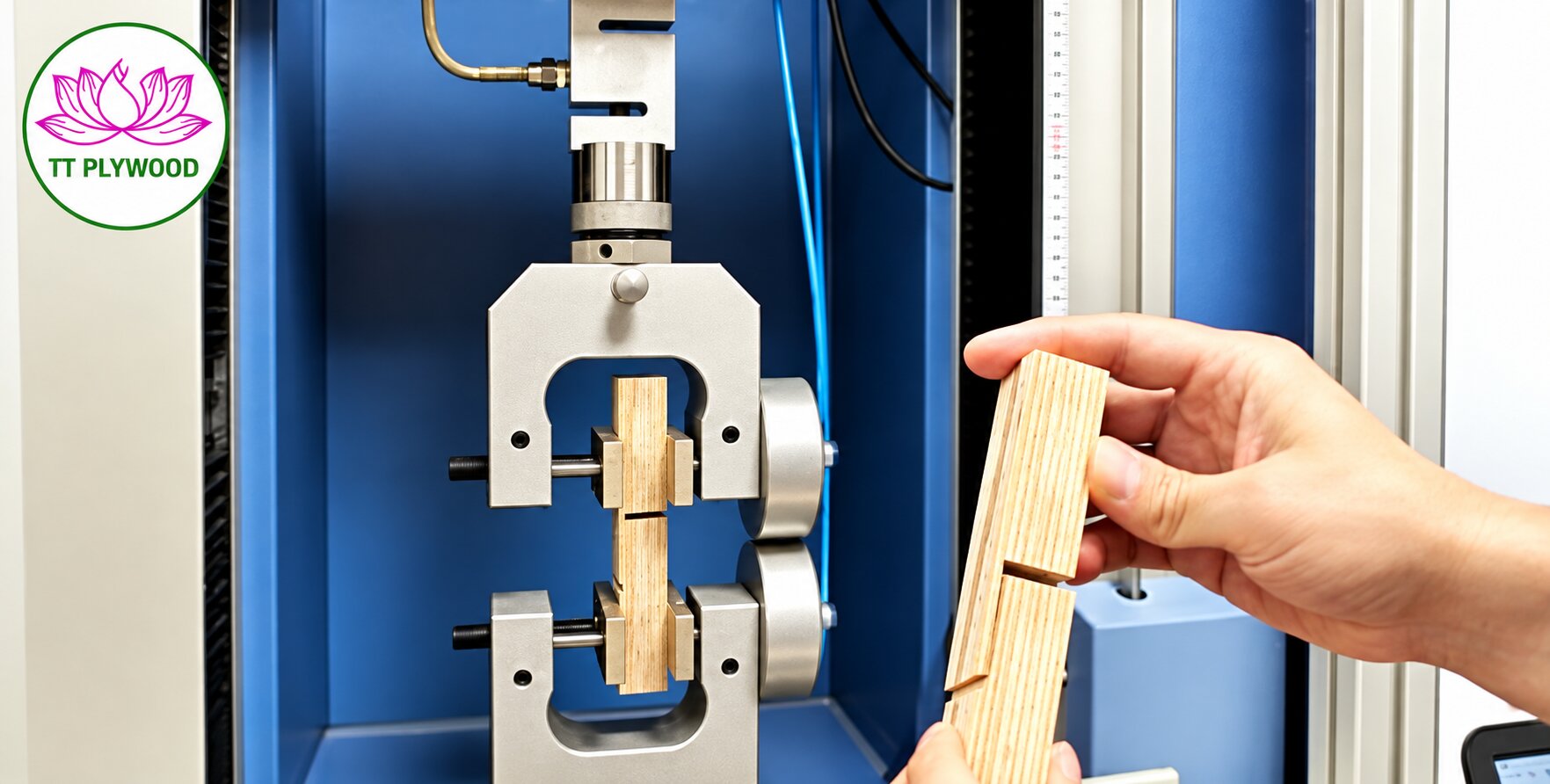
Image adapted from Mecmesin, “Lap shear testing of plywood.”
Marine Grade and Structural Performance Need More Evidence
Marine plywood has requirements beyond surviving an informal boiling demonstration. BS 1088 addresses marine-plywood durability and bonding requirements, while also recognising that particular applications may require additional properties.
Likewise, load-bearing suitability cannot be established from boiling alone. Structural-plywood specifications address multiple characteristics, including construction, veneer grading, dimensions and adhesive bonds.
For concrete formwork, also check the facing, panel condition, relevant design information and handling requirements. A boil-test duration cannot be converted into a reliable number of pours.
How Should Buyers Interpret “72-Hour Boil Test” and WBP Claims?
“Passed a 72-hour boil test” sounds precise, but duration alone does not describe the complete procedure.
Before comparing suppliers, ask whether the treatment was continuous boiling or a sequence involving other stages. Confirm how specimens were prepared and what happened after conditioning.
A longer advertised test is not automatically stronger evidence than a shorter, properly documented assessment. Comparisons require equivalent methods and acceptance criteria.
Ask What “WBP” Means in the Quotation
WBP is commonly used in plywood trade descriptions for weather- and boil-resistant bonding. However, the label alone does not identify the exact test procedure, adhesive formulation or complete panel specification.
Manufacturers may connect that description to a recognised bonding class. Metsä Wood, for example, describes weather- and boil-resistant bonding in conjunction with EN 314-2 Class 3 for its FormPLUS product.
The useful purchasing information is the documented classification and supporting evidence—not the abbreviation by itself.
Compare Reports, Not Only Demonstration Videos
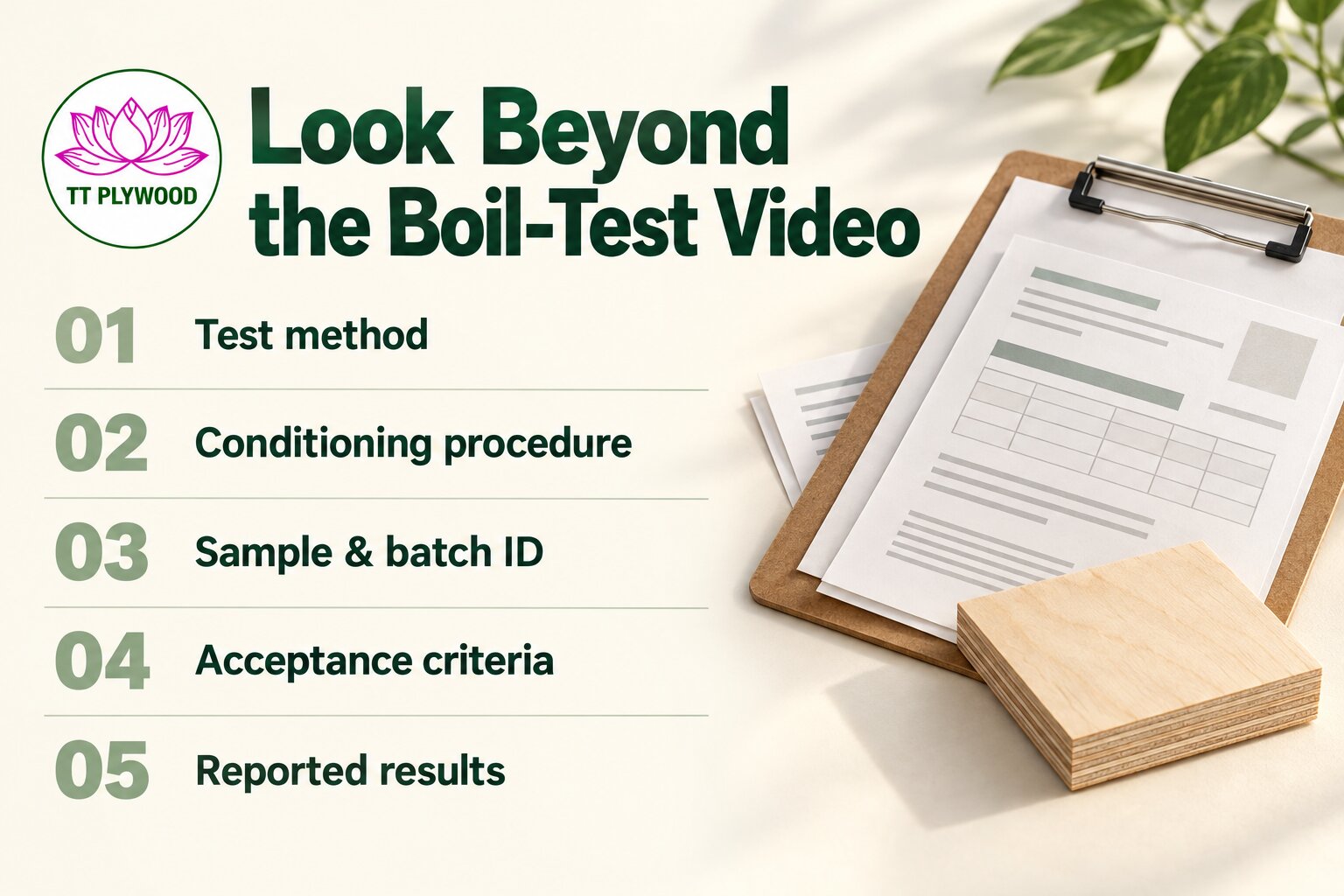
A video can show the test setup and visible sample condition. It usually cannot establish specimen traceability, compliance with every procedural requirement or the complete assessment results.
For repeat orders, agree on how tested samples will be connected to the production batch. A successful demonstration sample should not be treated as a guarantee covering every later shipment.
Frequently Asked Questions
Does Passing a Boil Test Make Plywood Waterproof?
No. It provides evidence about bonding under the tested conditions. It does not establish that the panel cannot absorb water or suffer moisture-related damage.
Does a Boil Test Confirm the Glue Type?
Not by itself. Performance under a particular procedure does not identify the adhesive’s chemical formulation. Request the manufacturer’s adhesive specification separately if this matters to the order.
Can a Factory Boil Test Replace a Laboratory Report?
An internal test can support production quality control. Whether it satisfies a purchase requirement depends on the agreed method, sampling and documentation. A demonstration video alone is not equivalent to a complete test report.
What Is the Main Takeaway for Plywood Buyers?
Treat boiling as one part of product evaluation. Confirm the method, inspect the results and match the evidence to the intended application. A clear specification is more useful than an impressive test-duration claim.
References
APA – The Engineered Wood Association (n.d.-a) Plywood. Available at: https://www.apawood.org/engineered-wood-products/plywood-osb/plywood/ (Accessed: 15 October 2026).
APA – The Engineered Wood Association (n.d.-b) Voluntary product standard PS 1-22, structural plywood. Available at: https://www.apawood.org/guides-tools-training/technical-document-library/standards/voluntary-product-standard-ps-1-22-structural-plywood/ (Accessed: 15 October 2026).
British Standards Institution (2004) BS EN 314-1:2004: Plywood. Bonding quality. Test methods. Available at: https://knowledge.bsigroup.com/products/plywood-bonding-quality-test-methods (Accessed: 15 October 2026).
British Standards Institution (1993) BS EN 314-2:1993: Plywood. Bonding quality. Requirements. Available at: https://knowledge.bsigroup.com/products/plywood-bonding-quality-requirements (Accessed: 15 October 2026).
British Standards Institution (2018) BS 1088:2018: Marine plywood. Requirements. Available at: https://knowledge.bsigroup.com/products/marine-plywood-requirements-1 (Accessed: 15 October 2026).
International Organization for Standardization (2007) ISO 12466-1:2007: Plywood — Bonding quality — Part 1: Test methods. Available at: https://www.iso.org/standard/40123.html (Accessed: 15 October 2026).
Metsä Wood (n.d.) Metsä Wood FormPLUS plywood. Available at: https://www.metsagroup.com/contentassets/139c3bf415c04a2e981d33add1e8dc36/725824.pdf (Accessed: 15 October 2026).
RISE (n.d.) Testing of load-bearing and non-load-bearing boards. Available at: https://www.ri.se/en/construction/wood-technology/service/testing-of-load-bearing-and-non-load-bearing-boards (Accessed: 15 October 2026).
Mecmesin (n.d.) Lap shear testing of plywood. Available at: https://www.mecmesin.com/publications/lap-shear-testing-plywood (Accessed: 16 October 2026).


