



-
-
-
Total payment:
-



US–Israel–Iran Tensions 2025: Oil Surge, Shipping Risks and the Impact on Global Plywood Trade
Posted by Thanh Uyên at 02/03/2026


Oil markets moved sharply higher following renewed tensions involving the United States, Israel and Iran, as traders priced in the risk of disruption to global energy flows (Reuters, 2025). Particular attention has focused on the Strait of Hormuz, one of the world’s most critical oil transit corridors (EIA, 2023).
For wood importers, plywood distributors and construction contractors, the implications are not abstract. Energy price volatility can quickly translate into freight instability, insurance surcharges and upward pressure on material costs.
This article examines how escalating geopolitical tension could affect:
- Oil and fuel prices
- Freight rates and marine insurance
- Plywood manufacturing costs
- Construction material pricing
- Import strategy in 2025
Oil Price Surge: Why Energy Drives the Timber Supply Chain
When crude oil rises, the impact spreads far beyond fuel stations. According to the U.S. Energy Information Administration (EIA, 2023), roughly one-fifth of global petroleum liquids transit through the Strait of Hormuz. Even perceived instability in this region can trigger immediate price reactions.
Higher oil prices affect the wood industry in three primary ways:
1. Production Energy Costs
Plywood manufacturing is energy-intensive. Veneer drying lines, hot presses and curing systems rely on electricity and thermal energy. Rising fuel costs can increase industrial energy tariffs, raising per-cubic-meter production costs.
2. Petrochemical-Based Adhesives
Phenolic and melamine resins used in structural and film-faced plywood are derived from petrochemical processes. Sustained crude price increases can influence resin pricing cycles.
3. Transport and Inland Logistics
Diesel prices directly impact trucking from factory to port. For containerized exports, even moderate fuel increases can significantly affect delivered pricing.
The World Bank (2023) has previously noted that energy shocks tend to feed into broader commodity and manufacturing inflation, particularly in energy-dependent sectors.
Freight Rates and War Risk Premium: The Immediate Trade Impact
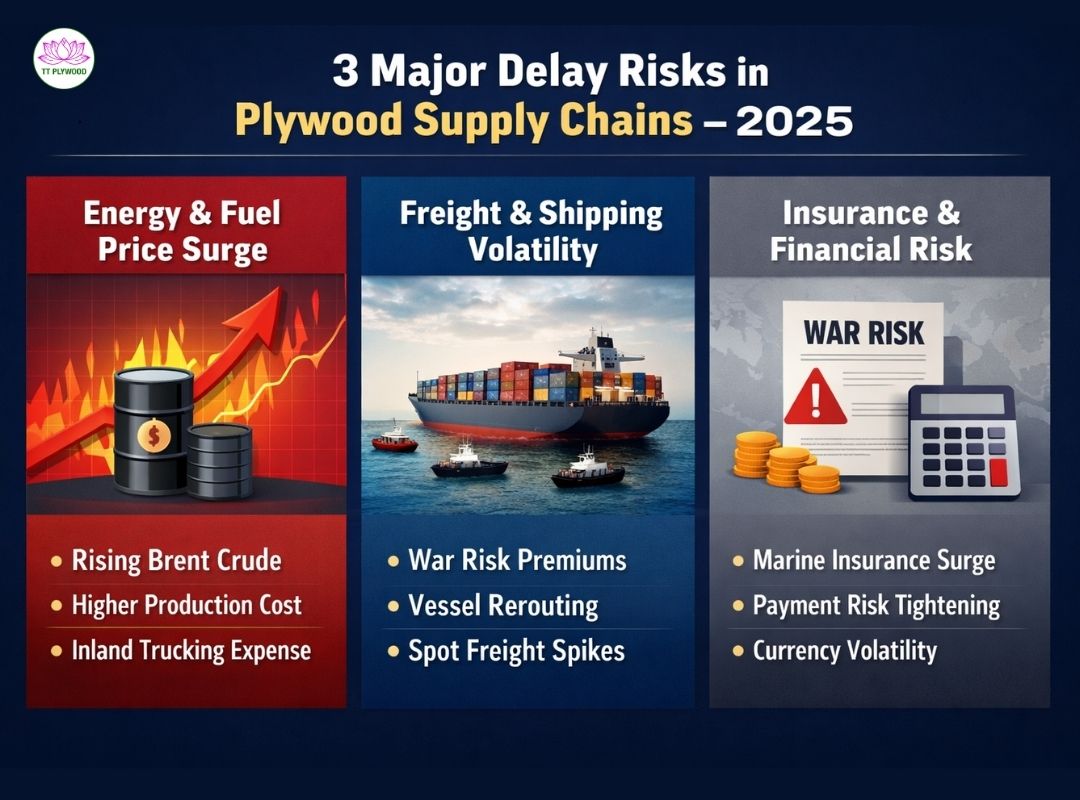
Another emerging risk is the return of the “war risk premium.” When geopolitical instability rises, marine insurers may impose temporary surcharges on vessels transiting high-risk waters.
Historically, conflict-related instability has led to:
- Increased marine insurance premiums
- Short-term freight rate spikes
- Vessel rerouting
- Tightened container capacity
Freight markets are often highly sensitive to geopolitical headlines. Even limited escalation can create volatility in spot rates and forward freight agreements.
For EU and US plywood importers operating under CIF contracts, this can lead to:
- Shorter price validity windows
- Upward freight adjustments
- Reduced cost predictability
Construction Sector Exposure to Energy Inflation
Energy volatility affects not only plywood but the entire construction ecosystem.
According to the International Monetary Fund (IMF, 2023), sustained energy price increases can accelerate cost pressures across industrial supply chains. In construction, this impacts:
- Cement production
- Steel manufacturing
- Heavy machinery operations
- Bulk material transportation
For contractors working on fixed-price agreements, energy-driven inflation introduces margin risk. Procurement teams must therefore monitor both oil trends and freight indices when planning material purchases.
Market Outlook 2025: Three Risk Scenarios
Scenario 1: Contained Escalation
Oil prices stabilize after initial volatility. Freight normalizes. Limited long-term impact on plywood pricing.
Scenario 2: Sustained Energy Pressure
Oil remains elevated for several months. Freight and insurance costs trend moderately higher. Gradual upward adjustment in export panel prices.
Scenario 3: Major Maritime Disruption
Significant disruption in Gulf shipping routes. Sharp freight spike. Broad inflation across construction materials.
At present, markets appear to be pricing in moderate sustained tension rather than extreme disruption (Reuters, 2025), but volatility remains elevated.
Strategic Guidance for Wood Importers and Contractors
In periods of geopolitical uncertainty, risk management becomes a competitive advantage.
Wood importers and construction buyers may consider:
- Monitoring Brent crude weekly
- Securing freight contracts earlier
- Negotiating flexible pricing mechanisms
- Diversifying supplier origins
- Prioritizing suppliers with stable production environments
Energy shocks often reward operational stability and transparent cost structures.
Conclusion: From Geopolitics to Panel Pricing
Escalating tensions in the Middle East have already influenced oil markets and freight sentiment. While plywood is not directly linked to regional trade routes, it is structurally exposed through energy, transport and petrochemical inputs.
For wood importers and construction contractors in 2025, monitoring oil prices and shipping risk is no longer optional — it is strategic procurement practice.
Geopolitical risk may begin with headlines, but it ultimately moves through balance sheets.
References (Harvard Style)
International Monetary Fund (IMF) (2023) Global Financial Stability Report. Washington, DC: IMF. Available at: https://www.imf.org (Accessed: 2 March 2026).
Reuters (2025) Oil rises on Middle East supply disruption concerns. Reuters Business News. Available at: https://www.reuters.com (Accessed: 2 March 2026).
U.S. Energy Information Administration (EIA) (2023) World oil transit chokepoints. Available at: https://www.eia.gov/international/analysis/special-topics/World_Oil_Transit_Chokepoints (Accessed: 2 March 2026).
World Bank (2023) Commodity Markets Outlook. Washington, DC: World Bank. Available at: https://www.worldbank.org (Accessed: 2 March 2026).


