



-
-
-
Total payment:
-



Film Faced Plywood Choosing Guide: Reduce Cost Without Sacrificing Durability
Posted by Hoàng Anh Tuấn at 22/05/2026

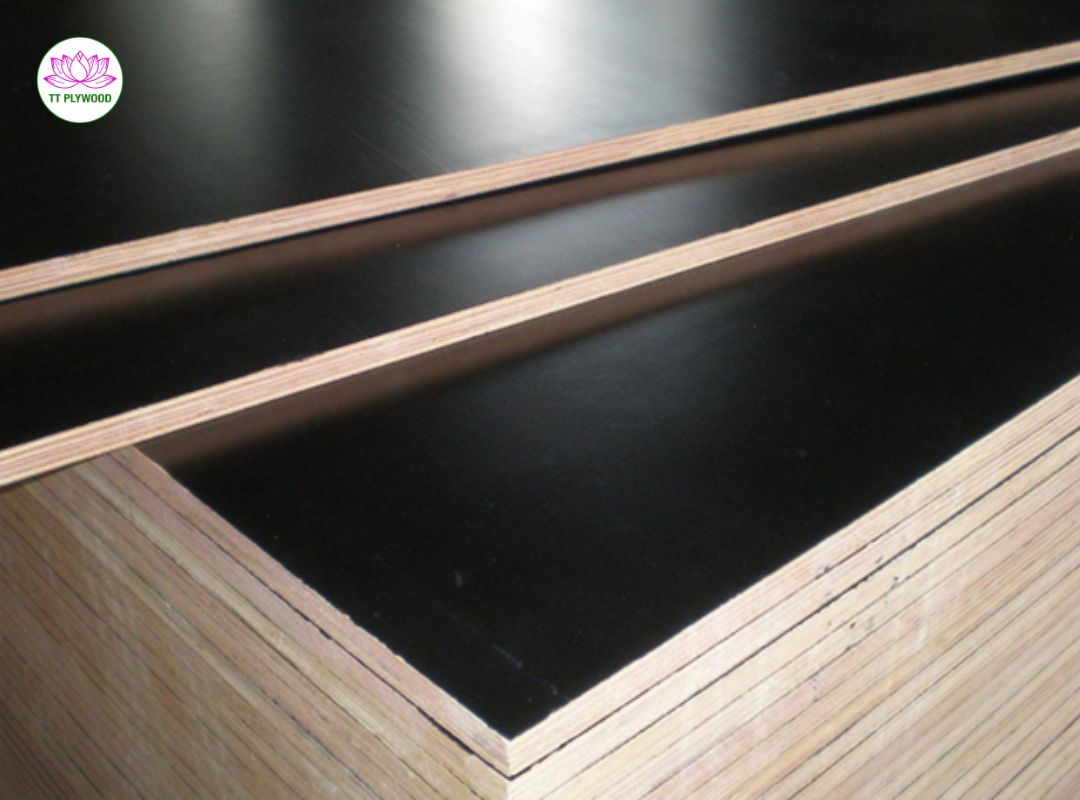
Selecting the right film faced plywood is a critical decision that impacts both the structural integrity of concrete and the project's bottom line. In professional formwork management, performance is defined by how a board maintains its structural properties under repeated exposure to moisture and pressure.
Why Do Contractors Often Choose the Wrong Film Faced Plywood?
Confusing glue names with real performance
Many buyers assume "WBP" on a label guarantees waterproof durability. In reality, WBP is a performance standard – not a specific glue formula. Suppliers may use low‑resin melamine (below 10%) and still call it WBP. Without checking resin concentration or boil test results, boards fail after 3–4 uses.
Over‑specifying for the wrong application
Using premium phenolic plywood (50+ cycles) on a small residential project drives up formwork costs by 30–50% with zero benefit. Conversely, using low‑cost melamine plywood on a high‑rise core wall leads to delamination, safety risks, and expensive rework.
Ignoring on‑site handling and maintenance
Even the best phenolic board will fail early if workers:
- Skip edge sealing after cutting
- Use metal crowbars directly on the film face
- Leave boards stacked flat on wet ground
Material quality alone cannot compensate for poor field practices. Most premature failures trace back to handling errors, not the plywood itself.
Relying only on price, not lifecycle cost
Buyers often pick the cheapest sheet without calculating cost per reuse. A board that costs 30% less but lasts half as many cycles is actually more expensive. Yet procurement teams rarely ask suppliers for verified reuse data or boil test certificates.
Why Glue Concentration is the Core of Formwork ROI
Note: ROI (Return on Investment) shows how much profit you earn compared to your investment cost. A higher ROI means better investment efficiency.
The adhesive system is the primary factor in plywood durability. In the B2B sector, understanding resin concentration is more important than simply knowing the glue name.
The Role of Resin in Water Boiled Proof (WBP) Standards
While many market options use generic glues with low resin content (often below 10%), high-performance boards are engineered with specific concentrations to meet international standards (such as EN 314-2).
- Melamine 17% Concentration: This is a cost-optimization benchmark. It provides sufficient bonding strength for 4–8 reuse cycles, making it the ideal choice for residential foundations where a 72-hour boiling test is not a technical requirement.
- WBP Melamine (Improved Grade): Featuring a higher resin concentration within the 7-20% range, this grade offers enhanced water resistance, typically surviving 10–15 hours of boiling. It is a versatile solution for medium-scale commercial projects requiring 8–12 reuse cycles.
- WBP Phenolic (100% Resin): This grade is designed for high-stress environments. Using 100% phenolic resin allows the board to survive a 72-hour boiling test, which is essential for massive infrastructure and high-rise core walls.
Technical Comparison: Glue Types vs. Performance
|
Feature |
Melamine 17% |
WBP Melamine |
WBP Phenolic |
|
Boiling Test Resistance |
4 – 6 Hours |
10 – 15 Hours |
Up to 72 Hours |
|
Typical Reuse Range |
4 – 8 Cycles |
8 – 15 Cycles |
25 – 50+ Cycles |
|
Core Material |
Acacia / Eucalyptus |
100% Eucalyptus |
Grade A Eucalyptus |
|
Best For |
Low-rise Residential |
Medium Commercial |
Infrastructure / High-rise |
*Note: Actual reuse cycles are estimates based on standard handling procedures and performance benchmarks: ASTM D3043 ( flexural properties) and ASTM D3501 (strenght comparison), alongside proper onsite maintenance
Maximizing Lifespan: The Maintenance Factor

In practice, the maintenance capability of the workforce often has a greater impact on lifespan than the material grade itself. To achieve the estimated reuse cycles, the following Buying & Handling Checklist must be implemented:
Professional Handling Checklist:
- Edge Sealing: All cut edges must be resealed with waterproof acrylic paint immediately to prevent moisture wicking.
- Release Agent Application: Use high-quality oil-based agents before each pour to ensure a clean strip.
- Proper Stripping: Avoid using metal crowbars directly against the film surface to prevent scratching.
- Cleaning & Storage: Clean concrete residue immediately after stripping and store boards flat in a shaded, dry area.
Common Procurement Mistakes to Avoid
- Over-specifying Material: Using premium WBP Phenolic for a 2-story project leads to unnecessary budget waste.
- Underestimating Edge Sealing: Even the best phenolic board will delaminate prematurely if the core is exposed to standing water through unsealed edges.
- Ignoring Density: A high-quality board should have a density of 600 - 650 kg/m³ for Eucalyptus cores to ensure screw-holding power.
Frequently Asked Questions (FAQ)
What is the difference between WBP and Melamine glue?
WBP (Water Boiled Proof) is a performance standard, not a glue name. Melamine glue can be WBP if the resin concentration is high enough to survive boiling water for a specific duration (usually 4+ hours).
How can I verify the quality of film faced plywood on-site?
The most reliable field test is the Boiling Test. Submerge a sample in boiling water; a high-quality Phenolic board should not show signs of delamination for at least 48–72 hours.
Why does the core material matter for film faced plywood?
The core (Eucalyptus, Acacia,...) determines the structural strength and how many times you can re-drill holes for tie-rods without the wood splitting.
Conclusion: Balancing Technical Requirements with Budget
Effective procurement is about finding the "Technical Fit." By aligning the glue concentration with the project's required reuse cycles and ensuring strict onsite maintenance, contractors can reduce total formwork costs by up to 40% without compromising concrete quality.
Tags :
cheap plywood
construction plywood
film faced plywood
Plywood construction
TTPLYWOOD
Vietnamese plywood


