



-
-
-
Total payment:
-




1/4 Inch Plywood Types: Baltic Birch, Maple, and Marine Uses Explained
Posted by Thanh Uyên at 26/03/2026

Introduction: Why 1/4 Inch Plywood Matters in Modern Applications
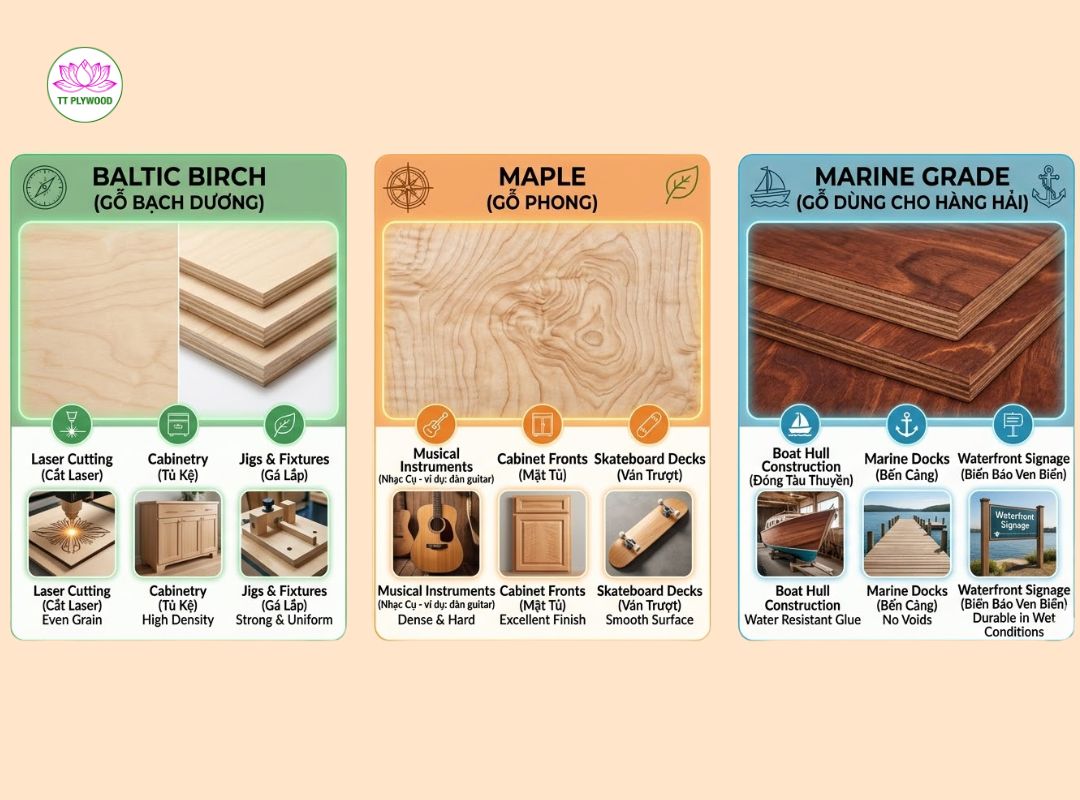
In global plywood sourcing, thickness is not just a specification - it directly affects performance, flexibility, and cost efficiency. Among all thickness options, 1/4 inch plywood stands out as one of the most widely used materials across furniture manufacturing, interior applications, packaging, and even certain marine environments.
For buyers in Europe, North America, Korea, Japan, and the Middle East, selecting the right type of 1/4 plywood is not simply about choosing a thin panel. It is about understanding how different materials such as Baltic birch, maple, and marine plywood behave under specific conditions.
In many sourcing cases, buyers often compare material options for interior and furniture applications, especially when deciding between birch and maple surfaces. A deeper breakdown can be found in the birch or maple plywood pros and cons, which explains key differences in structure, appearance, and application suitability.
When moisture resistance becomes a key requirement, selecting the right panel becomes even more critical. The structure and durability of marine-grade panels are explained clearly in this marine plywood guide, covering bonding systems and performance under humid conditions.
For buyers sourcing from Asia, particularly Vietnam, it is also useful to understand how materials are produced and supplied. This is covered in detail in the birch plywood in Vietnam overview, which provides insights into sourcing and production practices.
Although these panels share the same thickness, their structure, bonding performance, and intended use can vary significantly. Choosing the wrong type can lead to performance issues, higher costs, or reduced product lifespan.
Understanding 1/4 Inch Plywood: Structure and Characteristics
1/4 inch plywood, also referred to as 6mm plywood, is a thin engineered wood panel made by bonding multiple veneer layers together. Its main advantages include flexibility, lightweight structure, and ease of handling.
Compared to thicker panels, 1/4 plywood is typically used in applications where:
- Structural load is not the primary requirement
- Weight reduction is important
- Surface finishing and appearance are critical
Because of its thin structure, the internal composition becomes more sensitive to quality variations. Any inconsistency in veneer quality or bonding performance can significantly affect durability.
This is why bonding strength is often evaluated using standards such as the EN 314 bonding test (pillar article), which measures how well glue lines perform under stress and moisture conditions.
1/4 Baltic Birch Plywood: Strength and Consistency
Among all types, 1/4 Baltic plywood is widely recognized for its structural consistency and stability.
Baltic birch plywood is manufactured using multiple layers of high-quality birch veneer, resulting in a dense and uniform panel with minimal internal voids. This structure provides excellent dimensional stability and predictable performance.
In practical applications, 1/4 Baltic plywood is commonly used for:
- Furniture components and cabinet backing
- CNC cutting and precision manufacturing
- Interior panels requiring smooth finishing
Because of its uniform structure, Baltic plywood is particularly suitable for applications where precision and reliability are required.
1/4 Maple Plywood: Surface Quality and Aesthetic Value
While Baltic birch focuses on structural integrity, 1/4 maple plywood is often chosen for its visual appeal.
Maple veneer offers a clean, light-colored surface that is ideal for painting, laminating, or decorative finishing. This makes it a popular choice in furniture and interior design.
Typical applications of 1/4 maple plywood include:
- Decorative panels
- Furniture backing and interior components
- Cabinetry with visible surfaces
However, buyers should be aware that maple plywood may use different core materials depending on the manufacturer. As a result, it is important to evaluate not only the surface veneer but also the internal structure and bonding quality.
1/4 Marine Plywood: Performance in Humid and Outdoor Conditions
For environments where moisture is a concern, 1/4 marine plywood is designed to provide enhanced durability.
Marine plywood is typically produced using waterproof adhesive systems, such as phenolic glue, combined with higher-grade veneers. This reduces the risk of delamination and improves performance in humid conditions.
Compared to standard plywood, 1/4 marine plywood offers:
- Higher resistance to water exposure
- Stronger bonding performance
- Longer lifespan in demanding environments
It is commonly used in:
- Marine applications and boat interiors
- Outdoor furniture
- Packaging exposed to variable climates
Although marine plywood generally comes at a higher cost, it provides better long-term value in conditions where standard plywood may fail.
Key Differences Between Baltic, Maple, and Marine Plywood
Even though all three types fall under the category of 1/4 inch plywood, their performance characteristics differ significantly.
The key differences can be summarized as follows:
- Baltic plywood offers structural consistency and stability
- Maple plywood focuses on surface quality and appearance
- Marine plywood provides moisture resistance and durability
For buyers, the choice should always be based on application requirements rather than price alone. Selecting the wrong material can lead to reduced performance and higher long-term costs.
How Bonding Quality Affects 1/4 Plywood Performance
Because 1/4 plywood is relatively thin, bonding quality plays a critical role in its performance.
Weak bonding can lead to:
- Delamination under moisture or stress
- Reduced durability over time
- Inconsistent product quality
Understanding the causes of bonding failure is essential for buyers. A detailed explanation can be found in this why plywood delaminates guide (pillar cluster article), which highlights common risks and prevention strategies.
For applications requiring high durability, such as construction or marine use, ensuring strong bonding performance is essential.
How to Choose the Right 1/4 Inch Plywood
Selecting the right plywood involves balancing technical requirements, application needs, and supplier reliability.
A few practical considerations include:
- Choose Baltic plywood for precision and structural consistency
- Select maple plywood for decorative and interior applications
- Use marine plywood for humid or outdoor environments
Beyond product selection, evaluating supplier capability is equally important. Buyers should consider production consistency, quality control systems, and export experience.
For a broader overview of available plywood products across different specifications, you can explore the full range here:
https://ttplywood.com/all-products
Additionally, understanding supplier positioning and industry experience can help build confidence in long-term cooperation:
https://www.linkedin.com/in/tt-plywood/
Common Mistakes When Buying 1/4 Inch Plywood
Despite its simplicity, sourcing 1/4 inch plywood involves several potential risks.
Common mistakes include:
- Focusing only on surface appearance without checking internal quality
- Assuming all 1/4 plywood types perform the same
- Ignoring bonding standards and glue systems
- Choosing suppliers based solely on price
In many cases, these issues only become visible after the product is in use, making them costly to resolve.
Why 1/4 Inch Plywood Remains Popular Globally
The demand for 1/4 inch plywood continues to grow due to its versatility and cost efficiency.
Its lightweight nature reduces transportation costs, while its flexibility allows it to be used across a wide range of industries. For exporters, this makes it a strategic product suitable for multiple markets.
At the same time, increasing quality expectations particularly in Europe and developed markets require suppliers to maintain consistent production and reliable performance.
Key Takeaways for Buyers
When sourcing 1/4 inch plywood, buyers should keep several key principles in mind:
- Not all 1/4 plywood types are the same material and structure matter
- Application determines whether Baltic, maple, or marine plywood is suitable
- Bonding quality is critical, especially for thin panels
- Supplier consistency is more important than one-time sample quality
- Lower price often comes with higher long-term risk
Final Thoughts
In international plywood sourcing, thickness alone does not define performance. Even within the category of 1/4 inch plywood, differences in material, bonding, and manufacturing processes can lead to significantly different outcomes.
For professional buyers, the key is to understand how each type of plywood performs under real conditions. By selecting the right material for each application, it is possible to achieve both cost efficiency and long-term reliability.
Frequently Asked Questions (FAQ)
What is 1/4 inch plywood used for?
It is commonly used for furniture backing, cabinetry, decorative panels, and lightweight applications where flexibility and surface quality are important.
What is the difference between 1/4 Baltic plywood and 1/4 maple plywood?
Baltic plywood focuses on structural consistency, while maple plywood is primarily used for its smooth and decorative surface.
Is 1/4 marine plywood waterproof?
It is designed to be water-resistant due to waterproof adhesives, but it is not completely waterproof under all conditions.
Can 1/4 plywood be used outdoors?
Only marine-grade plywood is suitable for outdoor or humid environments. Standard plywood may fail under such conditions.
How can buyers ensure consistent quality?
By verifying bonding standards, checking supplier reliability, and conducting inspection before shipment.
References
Forest Products Laboratory, 2010. Wood Handbook: Wood as an Engineering Material. USDA.
APA – The Engineered Wood Association, 2021. Plywood Design Guide.
European Committee for Standardization (CEN), 1993. EN 314 Bonding Standards.
European Committee for Standardization (CEN), 2004. EN 13986 Construction Panels Standard.


