



-
-
-
Total payment:
-



Does Climate Affect the Type of Plywood You Should Import? A Guide for Global Buyers
Posted by Thanh Uyên at 21/09/2026

Why Climate Matters When Importing Plywood
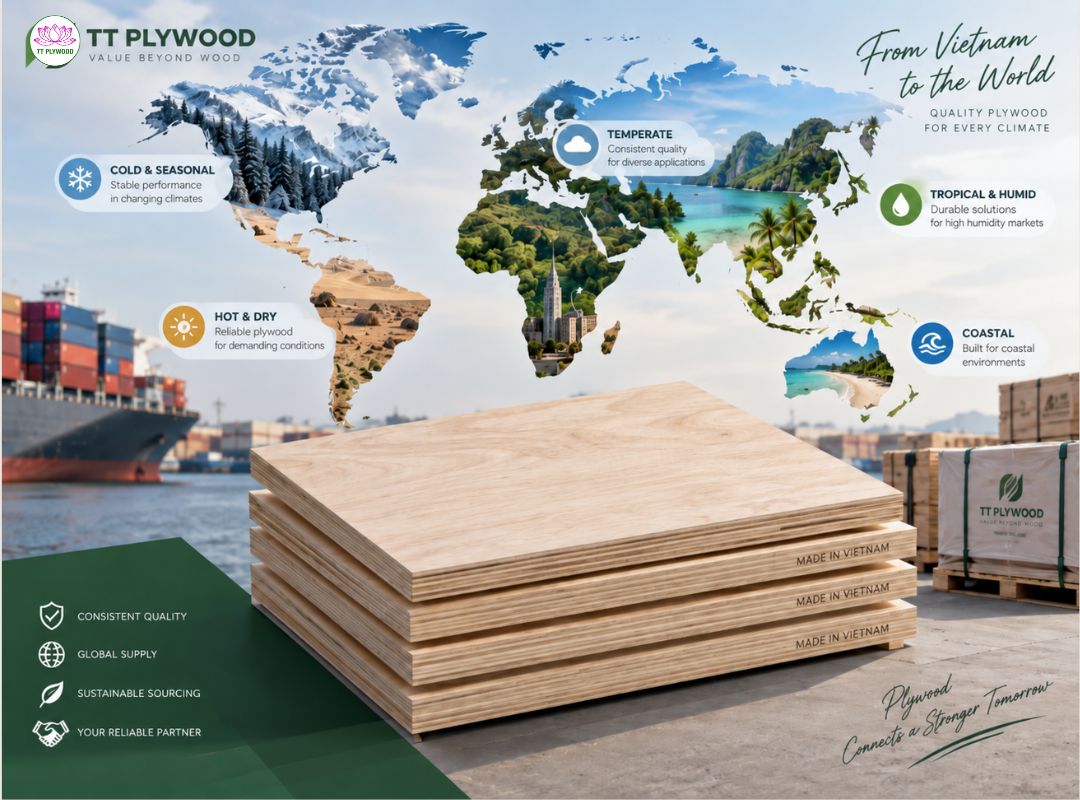
For international plywood buyers, product selection is usually based on application, price, thickness, core material, surface quality, and technical requirements. However, one factor is sometimes considered too late in the purchasing process: the climate where the plywood will be transported, stored, processed, and finally used.
Plywood is an engineered wood product made from multiple layers of veneer bonded together. Like other wood-based materials, it interacts with moisture in the surrounding environment, which means significant changes in humidity and storage conditions may influence dimensional stability and the condition of the finished panel. This does not mean that every buyer in a humid country needs marine plywood, or that one specification will automatically perform poorly in a dry or cold market. Climate should be considered together with the final application, moisture exposure, core construction, bonding system, plywood size tolerance, storage conditions, and quality requirements.
For importers sourcing plywood from Vietnam, understanding these factors before placing an order can help create a more suitable specification for the destination market and reduce misunderstandings during production and final inspection.
How Does Climate Affect Plywood?
Wood veneers can gain or lose moisture depending on relative humidity, temperature, storage conditions, and duration of exposure. Because plywood is made from multiple veneer layers, changes in the surrounding environment may influence panel dimensions and overall stability, especially when the difference between production conditions and the final environment is significant.
The effect is not the same for every plywood product. A panel stored indoors in a controlled warehouse faces very different conditions from plywood used outdoors, transported through humid environments, or repeatedly exposed to moisture. Similarly, plywood used for furniture may require different controls from plywood intended for construction or export packaging.
For this reason, buyers should not choose plywood based only on the climate of a destination country. A more useful question is: What conditions will the plywood actually experience during transportation, storage, processing, and final use? This gives the manufacturer much more relevant information when preparing a production specification.
Plywood for Humid and Tropical Markets
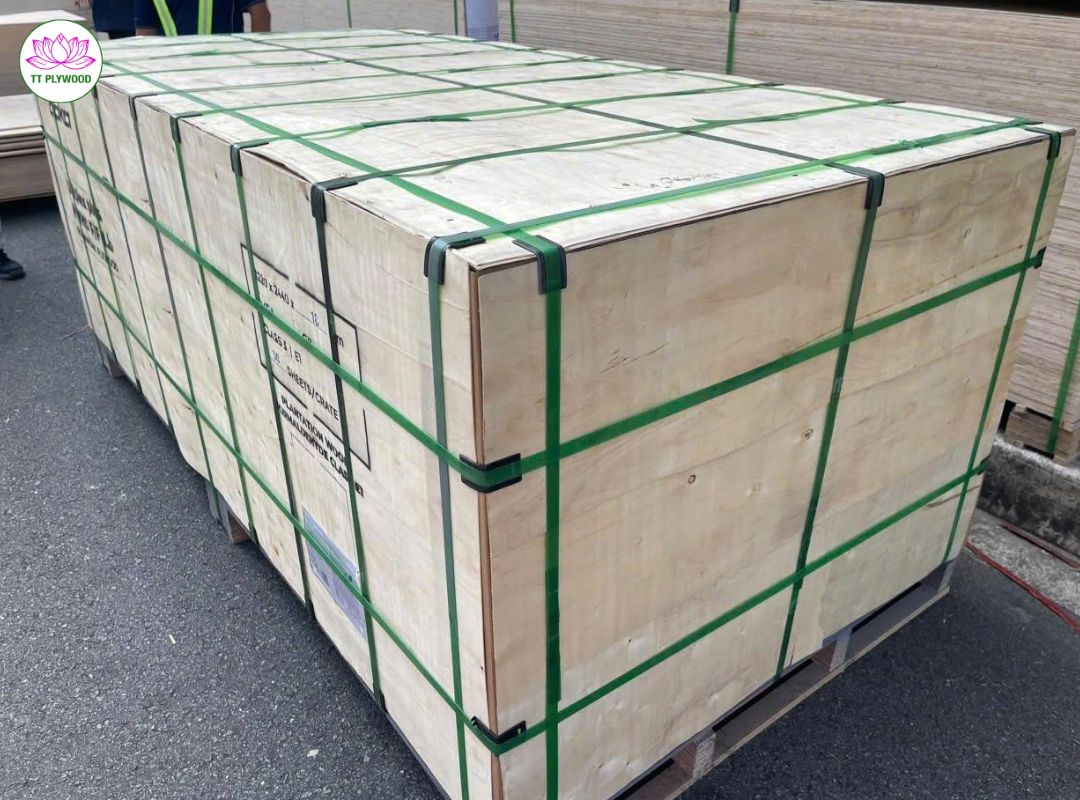
High-humidity conditions are common across many tropical and subtropical markets. In these environments, plywood may remain exposed to humid air during transportation, warehouse storage, and final use, making moisture control an important part of the purchasing specification.
Buyers should consider more than the moisture level of the finished sheet. Veneer preparation, core construction, bonding quality, and production consistency can all influence how the panel behaves when environmental conditions change. At the same time, specifying the most expensive plywood available is not necessarily the correct solution. The buyer should first determine whether the plywood will be used indoors, under partial exposure, or in an application where it may experience regular moisture contact.
For example, furniture plywood used inside a building in a tropical market may need stable moisture conditions and consistent construction, but it does not automatically require the same specification as plywood intended for exterior construction. Understanding the actual exposure level can help buyers avoid both under-specification and unnecessary cost.
How to Specify Plywood for Coastal and High-Humidity Markets
Coastal and high-humidity markets require particular attention because plywood may remain in moisture-rich environments for extended periods. Buyers importing plywood into these regions should normally focus on a combination of core quality, bonding performance, moisture control, dimensional consistency, and appropriate export packing.
The final application should always come first. Indoor furniture located near a coastline does not experience the same conditions as an exterior plywood component. Likewise, plywood used for export packaging may need reliable moisture stability during transportation without requiring the same performance level as panels exposed directly to outdoor weather.
A basic purchasing specification for humid destinations may include:
| Specification | What Buyers Should Consider |
|---|---|
| Application | Indoor, semi-exposed, or outdoor |
| Core | Species and internal construction |
| Bonding | Suitable for expected moisture exposure |
| Moisture | Agreed production requirement |
| Plywood Size | Length × width × thickness |
| Tolerance | According to final application |
| Surface | According to end-use requirements |
| Packing | Suitable export protection |
| Inspection | Pre-shipment quality control |
The purpose is not to make an order unnecessarily complicated. The objective is to identify the technical factors that actually influence performance in the buyer's application.
Choosing the Right Plywood Core for Different Climate Conditions
The plywood core plays an important role in panel performance, but the name of the wood species alone does not define the final quality. Depending on the product and buyer requirements, manufacturers may use eucalyptus, acacia, poplar, mixed hardwood, or other veneer combinations.
For example, hardwood plywood is commonly selected when buyers require a relatively dense panel structure, consistent machining characteristics, or particular performance requirements. However, describing a product as hardwood plywood does not automatically mean that it has high moisture resistance. Buyers should also consider veneer consistency, core gaps, overlaps, internal joints, bonding quality, and moisture control.
These factors become particularly important when plywood will be cut, drilled, or CNC-machined because internal defects may become visible after processing even when the surface looks acceptable. Buyers who need more information about this difference can internally link to Commercial Plywood – Selecting the Core Veneer.
Is Hardwood Plywood Suitable for Humid Markets?
Hardwood plywood can be suitable for many humid-market applications, but the term should not be treated as a guarantee of moisture resistance. “Hardwood” mainly describes the wood material used in the panel, while moisture performance depends on the entire plywood construction, including adhesive selection, veneer preparation, pressing conditions, internal quality, and expected exposure during use.
For this reason, an RFQ stating only “18 mm hardwood plywood for humid conditions” still leaves many important questions unanswered. A more useful request would also define the application, dimensions, surface requirements, bonding expectations, thickness tolerance, packing, and inspection conditions.
The clearer the specification, the easier it becomes for a manufacturer to recommend the correct product rather than making assumptions about what the buyer means by “humid conditions.”
When Should Buyers Consider Marine Plywood?
The term marine plywood is strongly associated with moisture-resistant applications, but buyers should not assume that every project in a tropical or coastal country automatically requires marine plywood. The correct product depends on the actual exposure conditions and the performance expected from the finished panel.
Marine plywood may be considered when the application requires a higher level of durability under moisture exposure and when the panel construction and bonding system are designed for those conditions. However, indoor furniture installed in a coastal region may not require the same specification as plywood that will regularly be exposed to exterior moisture.
Similarly, an export packaging application may require stable construction and moisture-resistant bonding without necessarily requiring the same characteristics as marine plywood. For buyers, the better question is not simply “Is the destination humid?” but “How much moisture will this plywood actually experience throughout its service life?”
Bonding Requirements Matter More Than Product Names
Commercial descriptions such as “waterproof plywood,” “marine grade,” “WBP plywood,” or “moisture-resistant plywood” can sometimes be interpreted differently between suppliers and markets. Professional buyers should therefore focus on the required bonding performance and end-use conditions rather than relying only on a product name.
Different adhesive systems may be used depending on the plywood type and application. MR systems are generally associated with less demanding indoor conditions, while melamine and phenolic-based systems may be selected when higher moisture resistance is required. The final adhesive should always be discussed according to the product specification and expected application rather than chosen from a name alone.
Bonding should also be considered together with core construction. A stronger adhesive cannot compensate for poorly prepared veneers, excessive internal gaps, or inconsistent manufacturing. For importers, the combination of core quality and bonding performance is more useful than a broad claim such as “waterproof plywood.”
Moisture Content Before Shipment
Moisture control begins during veneer preparation and continues throughout plywood manufacturing. If veneer moisture is not properly managed before pressing, production consistency can become more difficult to maintain, while the moisture condition of the finished panel may influence storage, processing, and dimensional behavior after delivery.
Buyers with specific moisture requirements should discuss them with the manufacturer before production begins. There is no single moisture value that should automatically be applied to every plywood type, destination, and application because requirements may vary depending on panel construction, manufacturing conditions, final use, and target market.
The important point is that buyer and manufacturer agree on the requirement before production rather than introducing a new acceptance criterion only during final inspection.
Hot and Dry Markets Also Require Attention
Humidity is not the only environmental factor that international buyers should consider. Plywood imported into hot and dry markets may experience conditions that are significantly different from those during production or sea transportation.
A panel manufactured in a relatively humid environment may later be stored in a much drier warehouse or used inside a climate-controlled building. As the material adjusts to the new environment, changes in moisture may influence panel dimensions and behavior. This can be especially relevant for furniture components, CNC-processed panels, or applications where dimensional accuracy matters.
The solution is not simply to choose thicker plywood or a denser core. Consistent veneer preparation, moisture control, appropriate storage, and realistic dimensional requirements may be equally important.
Cold and Seasonal Markets
Markets with strong seasonal climate changes create another set of conditions for plywood. Panels may be shipped during one season, stored under different humidity levels, and later used inside heated or climate-controlled buildings.
Europe, Northeast Asia, and other seasonal markets can experience noticeable changes in temperature and humidity throughout the year. For furniture manufacturers, CNC processors, and industrial buyers, dimensional consistency may therefore become particularly important.
Instead of looking only at the outdoor temperature of the destination country, buyers should consider the entire product journey, including factory production, container shipping, port handling, warehouse storage, processing at the buyer's facility, and final use. The more precise the final application, the more important it becomes to coordinate plywood moisture, construction, and dimensional requirements.
Can Climate Affect Plywood Size and Dimensional Stability?
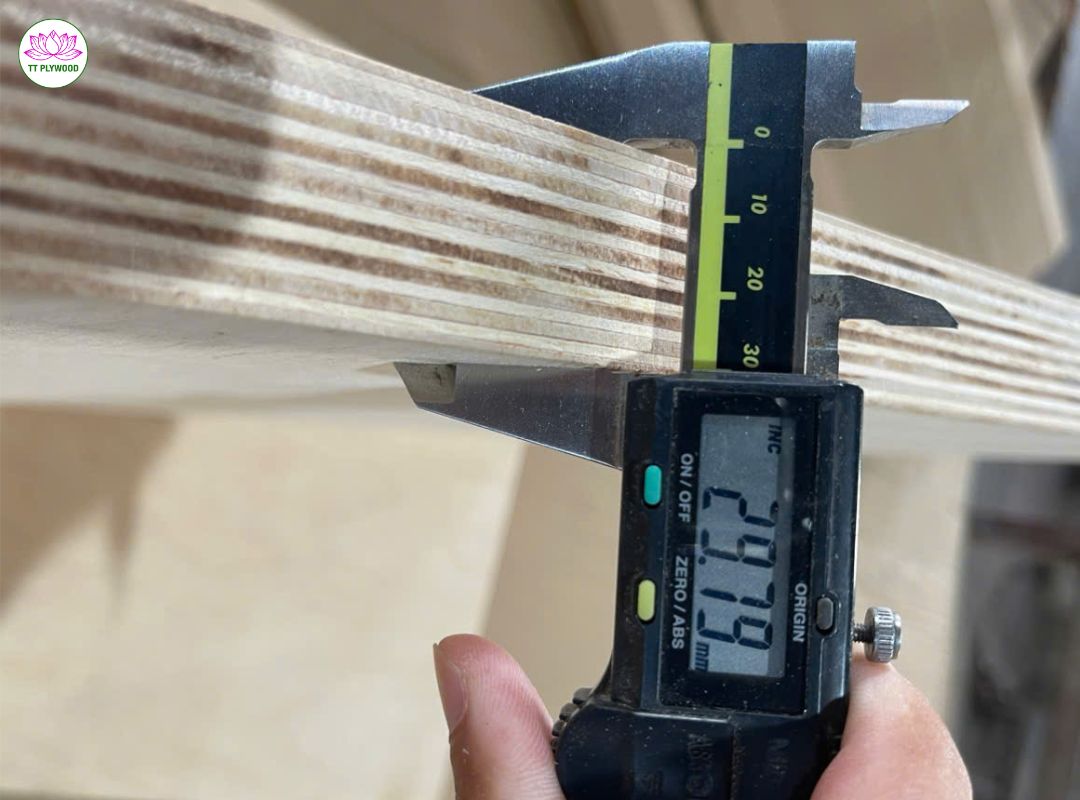
Yes. Changes in environmental moisture can influence the dimensions of wood-based products, making plywood size and dimensional tolerance important considerations for precision applications.
For example, a buyer may specify a nominal plywood size of 1220 × 2440 × 18 mm, but that information alone does not define the acceptable actual dimensions of the finished panel. For general packaging applications, minor dimensional variation may have little practical impact, while in CNC furniture manufacturing, automated assembly, or calibrated components, the same variation may affect processing accuracy and material yield.
Buyers should therefore distinguish between nominal plywood size and acceptable dimensional tolerance whenever dimensions are important to the final application. This does not mean that every plywood order needs extremely tight tolerances; the requirement should always be proportional to how the panel will actually be used.
Climate vs Application: Which Matters More?
Climate is important, but it should never be considered separately from the final application. A humid climate does not automatically require the most moisture-resistant plywood available, and a dry climate does not mean moisture or dimensional stability can be ignored.
The application determines what performance the plywood actually needs, while climate affects the conditions under which the panel must perform.
| Application | Environment | Main Specification Focus |
|---|---|---|
| Furniture | Humid indoor | Core, surface, moisture consistency |
| Export Packaging | Tropical or humid | Core, moisture, packing |
| Concrete Formwork | Wet or exposed | Bonding, surface film, durability |
| CNC Components | Seasonal | Core consistency, size tolerance |
| Outdoor Components | High exposure | Bonding and moisture resistance |
For international buyers, the most practical approach is to identify the application first, evaluate the expected environmental exposure, and then adjust the plywood specification accordingly.
Export Packing Matters Too
Even a well-specified plywood product can be affected by poor transportation and storage practices. During international shipping, plywood may remain inside containers for several weeks while moving through different temperature and humidity conditions, and under certain circumstances these changes can contribute to condensation.
Finished plywood bundles should therefore be prepared for export with suitable protection and handling methods. Depending on the buyer's requirements, this may include protective wrapping, strapping, pallets or skids, shipping marks, labels, and additional protection for sensitive surfaces.
After arrival, suitable storage remains important. Plywood should not be unnecessarily exposed to weather or poor warehouse conditions before processing. For an export plywood manufacturer, packing and loading should therefore be treated as part of the overall quality process rather than simply the final step before shipment.
Why the Same Plywood Specification Does Not Work for Every Market
Some international buyers use the same plywood specification across several destination countries because this simplifies purchasing and inventory control. This approach can work when applications and environmental conditions are similar, but problems may arise when one panel specification is used under very different conditions.
For example, a plywood specification originally developed for indoor furniture may not be suitable for semi-exposed packaging or exterior construction. Likewise, a product designed for one market may require adjustments in bonding, moisture control, packing, or dimensional tolerance when supplied to another.
The solution is not necessarily to create an entirely different product for every country. Buyers should instead identify which parts of the specification are affected by the destination and adjust only the characteristics that matter. This provides a more practical balance between performance, manufacturing efficiency, and purchasing cost.
What Buyers Should Tell the Manufacturer Before Ordering
A plywood manufacturer does not need a detailed climate report from the buyer, but a small amount of practical information can make the quotation and product recommendation much more accurate.
Buyers should ideally provide:
- Destination country or market
- Final application
- Expected indoor, humid, semi-exposed, or outdoor conditions
- Product type
- Required plywood size and thickness
- Core preference
- Face and back requirements
- Bonding requirement
- Important dimensional tolerances
- Packing and inspection conditions
For example, a buyer could specify: Destination: coastal European market; Application: furniture components; Environment: indoor with seasonal humidity changes; Product: hardwood plywood; Plywood Size: 1220 × 2440 × 18 mm; Core: eucalyptus; Main Requirement: stable machining and dimensional consistency; Packing: export standard; Inspection: pre-shipment QC.
This gives the manufacturer much more useful information than simply requesting “waterproof plywood.” .
How TT Plywood Supports Different Export Markets
At TT Plywood, plywood is manufactured for a range of international markets and applications. Before production, buyer requirements can be reviewed according to product type, plywood size, thickness, face and back, core material, adhesive system, final application, quantity, packing, and quality expectations.
For customized orders, technical clarification is particularly important because two buyers purchasing the same general plywood product may still require different specifications. Production quality also depends on several manufacturing stages, including veneer preparation, core selection, glue application, lay-up, pressing, repair, sanding, finishing, and final inspection.
Buyers can learn more through the TT Plywood Production Process, Quality Control, and Commercial Plywood – Selecting the Core Veneer pages. For international sourcing, the objective is not simply to manufacture the strongest or most expensive plywood possible, but to produce a panel that matches the buyer's actual application and market requirements.
Conclusion: Climate Should Modify the Specification, Not Define It Alone
Climate can influence plywood selection, but it should not become the only purchasing criterion. Humid, coastal, dry, and seasonal environments can create different considerations for moisture control, bonding, dimensional stability, plywood size tolerance, storage, and export packing.
However, the final application remains the most important starting point. A furniture manufacturer, packaging company, and formwork distributor may all operate in the same humid market while requiring completely different plywood specifications.
For international buyers, a more reliable purchasing process is to begin with the intended application and expected exposure conditions. From there, the buyer can define the appropriate core construction, bonding system, moisture requirements, plywood size and tolerance, packing method, and inspection criteria. For companies importing plywood from Vietnam, discussing these factors with the manufacturer before production can help create a more suitable specification and reduce misunderstandings during bulk orders.
FAQ
Does climate affect the type of plywood I should import?
Yes. Climate can influence moisture exposure, dimensional stability, storage conditions, and bonding requirements. However, buyers should also consider the final application and actual exposure conditions before selecting the plywood specification.
Is marine plywood necessary in tropical countries?
Not always. Marine plywood may be suitable for applications requiring higher moisture durability, but indoor or protected applications may use other plywood specifications depending on the required bonding performance and exposure level.
Is hardwood plywood suitable for humid climates?
Hardwood plywood can be suitable for humid environments, but hardwood core material alone does not guarantee moisture resistance. Bonding, veneer quality, moisture control, and overall panel construction should also be evaluated.
Can humidity affect plywood size?
Yes. Changes in environmental moisture can influence wood-based panel dimensions. Buyers using plywood for CNC machining, furniture production, or precision assembly should therefore consider both nominal plywood size and dimensional tolerance.
Does plywood for dry climates require special consideration?
Yes. Dry environments may create a significant difference between production conditions and final storage or use. Moisture stability, proper storage, and dimensional requirements can therefore be important, particularly for precision applications.
Should plywood specifications change between destination countries?
Not necessarily for every market. However, adjustments may be useful when destination countries have significantly different climate, storage, exposure, or end-use requirements.
References
Forest Products Laboratory. (2021). Wood Handbook: Wood as an Engineering Material. USDA Forest Service, FPL-GTR-282.
APA – The Engineered Wood Association. (2021). Moisture-Related Dimensional Stability (TT-028).
APA – The Engineered Wood Association. (2017). Moisture Exposure Recommendations for Wood Structural Panels (TT-002).
BSI. BS EN 636:2012+A1:2015 – Plywood. Specifications.
BSI. BS EN 314-2:1993 – Plywood. Bonding Quality – Requirements.


